Here's the catch: many people still equate minimalist with empty, sterile, or impersonal. That's a misunderstanding. True minimalist design is intentional simplicity, where every object, material, and color choice earns its place.
This article breaks down what aesthetic and minimalist design actually means, why it resonates so strongly right now, the core principles that separate good minimalism from bad, and the mistakes that turn a "calm" room into a cold one. Whether you're planning a home remodel or a boutique hospitality project, the goal is the same: fewer things, better chosen.
Key Takeaways
- Minimalist design means intentional simplicity: every object earns its place through function or story
- Gen Z embraces minimalism for its ties to sustainability, mental clarity, and mindful spending
- Warmth comes from texture, lighting, and personal touches, not stark, empty rooms
- Getting minimalism right demands more planning and sourcing expertise, not less
What Is Aesthetic and Minimalist Design?
Aesthetic and minimalist design is an intentional approach where form, function, and beauty work in tandem. Only elements that are genuinely useful or meaningful earn a spot in the room. That's the direct answer to "what is aesthetic and minimalist design": it's a filtering process, not a look you buy off a shelf.
There's a real difference between minimalism as a visual style and aesthetic minimalism as a philosophy. A visual style can be copied: white walls, a few plants, matte black hardware.
The philosophy runs deeper, asking whether each piece deserves to exist in that space at all. True minimalism means keeping only the right things, not achieving emptiness for its own sake.
Where the Aesthetic Comes From
Contemporary minimalist interiors borrow from several distinct traditions, not one single style:
- Wabi-sabi contributes beauty found in imperfection, patina, and the visible mark of a human hand
- Bauhaus, founded in 1919, brought a discipline of material honesty and function-first design
- Midcentury modernism simplified form and popularized the idea that "less is more"

According to Architectural Digest's overview of minimalist interior design, the style became recognized in its own right during the 1960s and 1970s, defined by clean lines, limited ornament, neutral color, and purposeful storage.
Signal Versus Noise
Borrowed from broader design theory, the "signal versus noise" concept is useful shorthand here. Every piece of furniture, every color choice, every decorative object should carry functional or emotional weight. If it doesn't, it's noise, and noise is exactly what minimalist design strips away.
That said, a common mistake is equating "empty" with "minimal." A well-designed minimalist room still needs enough context and personality to feel complete. Strip out too much, and you don't get calm. You get a room that feels unfinished, like the movers just left.
Why Minimalist Design Resonates Today
Minimalist spaces aren't just trendy. They tap into something psychological. Research published in the Journal of Environmental Psychology found that subjective feelings of clutter were more strongly associated with lower well-being than the actual number of items in a home. In other words, it's less about how much stuff you own and more about how much control you feel you have over it.
The Gen Z Factor
Ask why Gen Z likes minimalism, and the answer isn't really about aesthetics at all. It's about values.
Deloitte's 2024 Gen Z and Millennial Survey polled 14,468 Gen Z respondents across 44 countries. It found that 64% would pay more for environmentally sustainable products or services, while 40% reported feeling stressed most or all of the time.
Minimalism offers a visual language for intentional consumption and mental clarity, one that also happens to photograph well on a phone screen.
The Business Case
Physical spaces work a lot like digital interfaces: people form judgments fast. A cluttered lobby or an over-decorated guest room signals disorganization before a single word is spoken.
For boutique hotels and high-end residential real estate, that snap judgment has real financial weight. Perceived aesthetics shape a traveler's expected quality and willingness to book before they ever check in.
A property that feels thoughtfully edited, rather than randomly furnished, sets different expectations the moment someone scrolls through photos, and signals confidence the moment they walk through the door.
Quiet Luxury's Interior Crossover
There's also a broader cultural shift at play. "Quiet luxury," once mostly a fashion term describing low-key, logo-free status signals, has moved firmly into interiors, hospitality, and lifestyle branding. The common thread is restraint paired with material quality: fewer pieces, but each one built to last.
Core Principles of Aesthetic and Minimalist Design
Good minimalist design isn't accidental. It follows a handful of consistent principles, whether you're outfitting a hotel suite or a living room.
Function Before Form
Every piece in a minimalist space should serve a clear purpose. Before anything gets added to a room, ask what it does, not just what it looks like.
- A storage bench that hides linens beats a purely decorative bench that just takes up floor space
- An expandable dining table that flexes for guests beats a fixed table sized for a dinner party that rarely happens
- Lighting fixtures should provide usable light, not just visual interest
Decoration isn't banned, but it has to earn its place alongside function, not instead of it.
Curated Palette and Quality Over Quantity
Minimalist interiors typically lean on a restrained, cohesive palette: a handful of dominant tones with texture variation, rather than a dozen competing colors and patterns fighting for attention. In a boutique hotel lobby, that might mean anchoring the space in warm wood tones with a single brass accent, rather than scattering five different finishes throughout.
Just as important, investing in fewer, higher-quality pieces beats filling a room with mass-market items. A single custom or artisan-made dining table says more than five pieces from a big-box catalog, much like a hand-joined walnut console outshines a stack of flat-pack shelving units. Quality over quantity isn't a slogan here; it's the mechanism that makes restraint feel intentional rather than empty.
Visual Hierarchy, Negative Space, and Layered Warmth
Negative space, the deliberate breathing room around furniture and on walls, directs the eye toward what matters. It works the same way whitespace does in a well-designed app, guiding attention rather than sitting empty.
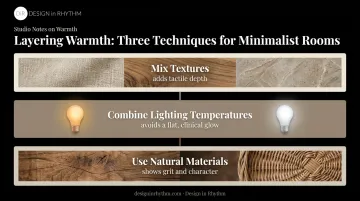
But negative space alone can feel cold. That's where layering comes in:
- Mix textures like linen, wood, and stone to add tactile depth
- Combine warm and cool lighting temperatures to avoid a flat, clinical glow
- Use natural materials that show grain, weave, or grit
Skip the layering, and a minimalist room risks feeling like a showroom instead of a home.
Best Practices and Common Mistakes to Avoid
Minimalist design done well takes more planning, not less. Here's what separates spaces that feel calm from ones that feel unfinished, or worse, cold.
Best Practices for Achieving Minimalist Design
- Start with discovery, not shopping. Identify what truly needs to remain based on lifestyle or brand story before adding anything new.
- Prioritize lighting design early. Minimalist rooms rely heavily on light to create mood and depth, since there's less visual noise to distract from a flat or harsh glow. In boutique hotels, layered lighting often does the work that multiple accent pieces used to do.
- Source multi-use, well-crafted pieces. Trend-driven furniture that needs replacing in two years works against the whole point of minimalism. Custom, well-made pieces hold their value and look good for a decade or more, unlike disposable trend items.
Common Mistakes That Undermine Minimalist Design
- Over-editing into sterility: removing every personality or story element leaves a space feeling unfinished, not calm
- Mismatched scale or proportion: an oversized sofa in a small room, or a tiny rug under a large sectional, disrupts the balance minimalism depends on
- Inconsistent materials or colors: mixing warm wood tones with cool metals without any bridging element reintroduces visual noise and breaks cohesion
The pattern across all three is the same: minimalism only works when restraint and intention move together. Drop one, and the whole thing falls apart.
How Design in Rhythm Brings Aesthetic Minimalism to Life
Achieving minimalist design at a professional level requires more sourcing expertise, not less. Every object has to be exactly right, since there's nowhere for a mediocre piece to hide. That's the gap Design in Rhythm was built to close.
The process starts with what the firm calls its Dream Phase, a discovery conversation that uncovers how a space will actually be lived in before any furniture or finish gets selected. The team explores:
- Who will use the space, and how, day to day
- What the household's daily rhythm looks like
- Whether pets, kids, or high-traffic zones will shape the design
As founder Jon Wheat puts it:
"We listen first. We design second."
For a minimalist project, that sequence matters. A client's real story is what keeps a restrained space from feeling generic.
From there, every product gets sourced from Design in Rhythm's network of vendors, artisans, and custom furniture makers before the team builds photorealistic renderings. That means clients approve the exact minimalist palette and materials they'll actually receive, not a rough approximation that might shift once ordering begins.
The firm's integrated design-to-installation process, covering design, procurement, logistics, and installation under one team, removes the vendor coordination guesswork that often derails minimalist projects. A single substituted material or a delivery that arrives out of sequence can undo an entire restrained composition.

Design in Rhythm has applied this approach across boutique hotels, restaurants, and residential remodels in markets including Los Angeles, Santa Barbara, and Washington DC, where precision in sourcing is what keeps a minimalist result from tipping into sterile or impractical.
Frequently Asked Questions
What is aesthetic and minimalist design?
It's an intentional design philosophy where only functional or meaningful elements make it into a space. The goal is balancing simplicity with beauty, not creating an empty room.
Why does Gen Z like minimalism?
Gen Z's preference ties to sustainability values, mental wellness, and intentional spending, plus a social-media aesthetic that rewards clean, uncluttered visuals. The aesthetic signals identity and values as much as it signals style.
Is minimalist design more expensive than traditional design?
Not necessarily. You buy fewer pieces, but minimalist design often relies on higher-quality, custom-sourced materials, so total project cost varies based on scope and sourcing choices.
Can a minimalist space still feel warm and inviting?
Yes. Texture, natural materials, layered lighting, and a few personal objects separate a warm minimalist room from a sterile one. Restraint in object count doesn't mean restraint in comfort.
What's the difference between minimalist and modern design?
Modern design refers to a specific historical style era, roughly the early-to-mid 20th century. Minimalism is a broader philosophy of reduction that can be applied across many design eras, including modern ones.
How do I start transitioning my home or space to a minimalist aesthetic?
Begin by decluttering and defining a core palette of two or three tones. Design in Rhythm's discovery process is built around this exact question, uncovering which pieces truly serve your space's purpose before you commit to them.