Introduction
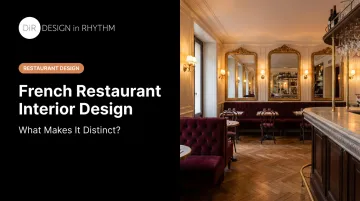
Walk into ten restaurants calling themselves "French," and you'll likely see ten different rooms wearing the same three or four tired props: a zinc bar, some black-and-white tile, maybe a chandelier bolted on for effect. That's the problem.
"French restaurant design" isn't one aesthetic. It's a lexicon of at least four distinct concepts, each with its own history, materials, and rules.
Many restaurant owners and designers blend bistro, brasserie, and café cues indiscriminately. The result feels like a costume, not a place. Discerning guests notice the difference immediately, even if they can't name what's off.
This guide breaks down what actually separates a bistro from a brasserie from a café, along with the materials and colors that define each. It also shows how a firm like Design in Rhythm translates that history into a functioning modern dining room.
Key Takeaways
- French dining ranges from casual cafés to grand brasseries, each with distinct history and style
- Zinc bars and bentwood chairs define the bistro; Belle Époque ornamentation defines the brasserie
- Warm, muted palettes with natural materials create authenticity that generic "French-ish" décor can't fake
- Bringing this style to a U.S. space means balancing history with code compliance and sourcing logistics
The French Restaurant Lexicon: Bistro, Brasserie, Café & Formal Restaurant
"French restaurant" is a catch-all term that hides real distinctions. Each concept below carries its own name, history, and design DNA, and mixing them without intention is how you end up with a room that feels staged rather than lived-in.
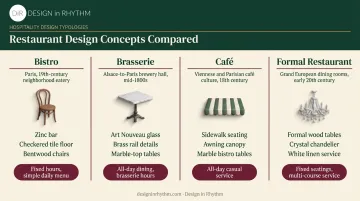
The Bistro
The word's origin is genuinely disputed. France's own Académie française links it to regional French terms like "bistraud" or "bistrouille" rather than the popular myth tying it to the Russian word for "quick." Whatever its roots, the bistro has always meant something small, family-run, and unpretentious.
Classic bistro design markers include:
- Zinc-topped bars — a democratic fixture once found on nearly every Parisian corner
- Black-and-white tiled floors, often laid in a checkerboard or herringbone pattern
- Poster-covered walls, layered with vintage advertising and event prints
- Bentwood or rattan chairs paired with small, round marble-top tables
Bistros run on fixed lunch and dinner service rather than continuous hours. The whole point is intimacy, not scale.
The Brasserie
"Brasserie" literally means brewery, and the connection isn't accidental. Many of Paris's most famous brasseries trace back to Alsatian owners who brought both beer-brewing traditions and a taste for grander dining rooms into the city.
Bofinger, founded in 1864 by Alsatian innkeeper Frédéric Bofinger, and Brasserie Lipp, opened in 1880, are two of the best-documented examples of this Alsatian lineage.
Where the bistro is modest, the brasserie leans into opulence. Bofinger's dining room still shows off its Art Nouveau glass dome, mosaic floors, and engraved mirrors. Lipp built its reputation on earthenware tiles, painted frescoes, ornate woodwork, and moleskin banquette seating.
Design markers to borrow from this concept:
- Ornate ceiling moldings and stained glass
- Statement chandeliers or large mirror installations
- Richer color schemes paired with marble-top tables
- Fixed banquette seating along the perimeter
Brasseries also earned their reputation as long-hours, all-day gathering spots. Historic patrons at Lipp reportedly included André Gide and François Mitterrand, while La Coupole drew Hemingway and Picasso through its doors.
The Café
A café's job was never really about the food. It was about coffee, conversation, and having somewhere to sit for three hours without anyone rushing you out.
Cafés like Les Deux Magots built entire cultural identities around this: the venue's own history credits it as a meeting point for Apollinaire, Gide, and later Sartre and Beauvoir.
Design formula for cafés stays simple and enduring:
- Sidewalk seating under awnings, positioned to catch foot traffic
- Small round tables sized for two, rarely more than four
- Wicker or lightweight metal chairs that stack easily
- Corner-hugging layouts shaped by narrow Parisian streets
The café's charm comes from restraint rather than decoration.
The Formal French Restaurant
This is the elevated tier, where dining stretches across breakfast, lunch, and dinner with a more polished service style. Furnishings here are built for durability across long service windows rather than pure atmosphere.
Expect to see:
- Formal wood tables and upholstered chairs replacing bentwood
- Private booths sized for family or business dining
- Finishes selected for easy maintenance through multiple daily services
Michelin itself has stated that decor and formality don't factor into star ratings, so don't confuse "formal" with "award-winning." It describes a service style rather than a ranking.
Core Design Elements That Define Authentic French Restaurant Interiors
Once you understand which concept you're building, the details need to reinforce it. These four categories are where authenticity either shows up or falls apart.
Color Palette
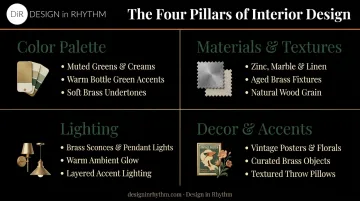
Soft greens, warm creams, and muted neutrals show up consistently across real French dining rooms — more so than the "soft blue everywhere" cliché many designers default to.
At Le Cornichon in Paris, designers built the palette around Bordeaux red, bottle green, cream, and chrome, calling it a classic Parisian-bistro combination. London's Socca restaurant took a related approach, layering terracotta, blue murals, cream, and oxblood for a French Riviera feel.
The pattern that emerges:
- A muted, earthy base (cream, green, or terracotta)
- One or two bold accent colors (deep red, mustard, burgundy) used sparingly
- Chrome or brass hardware to add contrast without competing
Bold accents work as seasoning, not the main course. Overdo them and the room starts to feel like a theme park.
Materials & Textures
Authentic French interiors lean on materials that age well and feel substantial underfoot and to the touch:
- Exposed wood beams and stone or brick surfaces for rustic texture
- Marble or zinc for bars and tabletops
- Linen, velvet, and leather for upholstery and drapery
Le Cornichon's designers mixed mosaic flooring with faux-travertine laminate and walnut-effect tabletops, proving that even budget-conscious materials can read as high-end when the palette and proportions are right.
Lighting
Warm, dimmable lighting isn't optional in a French dining room. It's the difference between a space that feels intimate and one that feels clinical.
Signature fixtures include:
- Brass sconces mounted along banquettes
- Statement pendant lights over bar or communal seating
- Crystal or deconstructed chandeliers in formal settings, as seen at Alain Ducasse au Plaza Athénée
- Table lamps or votive candles for soft pools of light at tabletop height
Decor, Artwork & Accents
Wall treatments do a lot of heavy lifting here. Vintage posters, oil paintings, and aged mirrors all signal French heritage instantly, without a single word of signage.
Finishing touches that complete the look:
- Café curtains hung at half-height on windows
- Fresh floral arrangements refreshed weekly
- Antique objects like candlesticks or ceramic pots scattered with intention, not symmetry
Furniture & Layout: The Backbone of French Ambiance
Furniture choices carry more of the "French feel" than most owners realize. Get this wrong and no amount of paint color will save the room.
Bentwood chairs are the universal signature. Michael Thonet's 1859 design, originally built for European coffeehouses, became the go-to seat across French bistros because it's light, stackable, and cheap to replace. Pair it with small round tables and you've got a layout that works even in a 400-square-foot footprint.
Banquette seating solves a different problem. Brasseries and formal restaurants use fixed bench seating along walls for three reasons:
- It maximizes covers per square foot
- It creates a sense of privacy for guests seated against the wall
- It reduces the furniture footprint needed for the same seating count
The real tension shows up in the U.S. Parisian bistros pack tables close because that's the culture and the real estate reality. American restaurants can't simply copy that density.
The 2010 ADA Standards set three baseline requirements:
- At least 5% of dining positions must be wheelchair accessible
- A minimum 36-inch clear route to reach those positions
- Dining surfaces between 28 and 34 inches high
ADA doesn't dictate one universal table-to-table gap for every restaurant. It does require dispersed accessible seating and clear paths of travel. That means European-style intimacy has to be redesigned around U.S. code, not just shrunk down and hoped for the best.
Bringing Authentic French Elegance to Modern Hospitality Spaces
Here's the real challenge: replicating a century-old Parisian aesthetic while making sure the kitchen still flows, staff can move efficiently, and the building department signs off.
That gap between inspiration photo and functioning restaurant is where most projects go sideways. A zinc bar top looks stunning in a rendering. Sourcing an actual zinc fabricator, getting it code-compliant, and installing it on schedule is a different problem entirely.
A Sourcing Network Retail Searches Can't Match
This is where an experienced hospitality design partner earns its fee. Design in Rhythm built its sourcing network over more than a decade, giving restaurant owners access to vendors, brands, artisans, and custom furniture makers that don't show up on a general retail search.
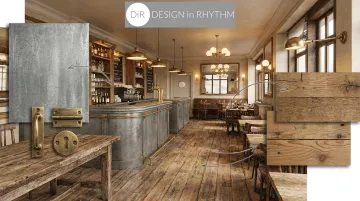
That network is what makes genuine zinc, brass, and reclaimed wood detailing possible, instead of a laminate imitation.
Sourcing Before Rendering, Not After
The firm's process also removes a lot of the guesswork that sinks hospitality buildouts. Rather than presenting a concept rendering and sourcing materials afterward, Design in Rhythm sources every product first, then builds the photorealistic 3D rendering around those exact confirmed materials.
What a client approves in the rendering is what actually gets installed. No surprises when the shipment arrives.
Details That Make or Break Authenticity
A handful of details make or break French restaurant authenticity:
- Zinc patina with the right aged tone, not a flat gray finish
- Chandelier scale sized correctly for the room
- Marble tabletops that are authentic stone, not printed laminate
That sequencing matters far more here than in a generic commercial buildout.
Common Design Mistakes to Avoid
Even well-intentioned projects stumble in predictable ways. Watch for these three traps:
- Mixing concepts into a disjointed mess. Layering bistro tile, brasserie chandeliers, and café curtains together produces visual confusion instead of a coherent French identity. Pick one concept and let every material reinforce it.
- Prioritizing looks over durability. Delicate reclaimed materials and antique fixtures photograph beautifully, but they chip, scratch, and fail fast in high-traffic zones like bar rails and entryways. Reserve delicate pieces for lower-contact areas and specify commercial-grade alternatives everywhere guests actually touch.
- Importing without adapting. European fixtures often don't meet U.S. electrical, humidity, or fire-code standards. That Paris flea market chandelier may need rewiring and UL certification before it can legally hang in an American dining room, so budget for that lead time and cost upfront.
Frequently Asked Questions
What is traditional French restaurant interior design?
It centers on warm, muted color palettes, natural materials like wood, stone, and zinc, and vintage-inspired lighting and décor. The specific furniture and finishes vary depending on whether you're designing a bistro, brasserie, café, or formal restaurant.
What is a French style restaurant called?
The main terms are bistro, brasserie, café, and restaurant. Bistros stay small and informal, brasseries run larger with continuous service, cafés keep the focus on drinks and conversation, while restaurants span the full range from casual to refined.
What's the difference between a bistro and a brasserie?
A bistro is small, family-run, and informal, typically with set meal hours. A brasserie is larger, historically tied to Alsatian beer-brewing traditions, and known for longer service hours and richer Art Nouveau or Belle Époque decor.
What colors work best for a French-inspired restaurant?
Muted greens, warm creams, and terracotta tones form the strongest base, based on real Parisian bistro palettes. Layer in bold accents like burgundy or mustard sparingly for warmth without overwhelming the room.
Can French restaurant design be adapted for a modern American space?
Yes. Success depends on balancing authentic materials, lighting, and furniture styles with U.S. accessibility codes, fire regulations, and practical service flow, rather than copying a Parisian layout directly.
How much does it cost to design a French-style restaurant interior?
Costs vary widely based on square footage, material sourcing complexity, and how much custom furniture the project requires. Design in Rhythm provides a tailored estimate once we understand your specific space, vision, and level of custom fabrication needed.