
Procurement is not shopping. It's a strategic, multi-phase discipline involving dozens of vendors, precise specifications, tracked shipments, warehouse logistics, and careful sequencing — all happening simultaneously while the client focuses on other things.
This article breaks down what procurement actually means in interior design, why it has such a direct impact on your final result, and what to look for when choosing a design partner who takes it seriously.
Key Takeaways
- Procurement covers sourcing, purchasing, tracking, delivery, inspection, and installation of every item in a space
- Managed well, it protects your timeline, budget, and design vision — managed poorly, it unravels all three
- Trade relationships built over a decade or more give experienced designers access to vendors unavailable to the public
- Poorly managed procurement is one of the most common reasons projects finish late, over budget, or compromised
- Integrated procurement means one accountable team from the first purchase order to the final walkthrough
What Is Procurement in Interior Design?
Procurement is the full process of identifying, sourcing, purchasing, tracking, and delivering every physical item required to complete a design project — furniture, lighting, custom pieces, finishes, accessories, artwork, and more.
The distinction between design and procurement matters. The design phase determines what goes into a space. Procurement is the system that makes sure those exact items actually arrive correctly, on time, and in the right condition. One is creative; the other is operational.
FF&E and OS&E: The Core Categories
The primary category procurement manages is FF&E — Furniture, Fixtures, and Equipment. These are the longer-lived, movable items that define a space: sofas, beds, lighting, case goods, rugs.
In boutique hospitality projects, procurement scope extends to OS&E — Operating Supplies and Equipment: linens, cutlery, housekeeping supplies, guestroom amenities, and similar operational goods. ISHC's hospitality procurement guidance describes OS&E procurement as encompassing sourcing, supplier selection, consolidation, and delivery management — a scope far beyond simple purchasing.
Why Hospitality and High-End Residential Projects Are Especially Complex
These project types share several characteristics that make procurement genuinely difficult:
- High item counts across multiple zones or rooms
- Long lead times on custom and imported pieces — domestic casegoods can run 12–16 weeks; overseas pieces often exceed 16–18 weeks
- Multiple vendors managed simultaneously, each with their own timelines and terms
- **Delivery timing that must align with construction milestones** — a piece arriving three weeks early is almost as problematic as one arriving three weeks late
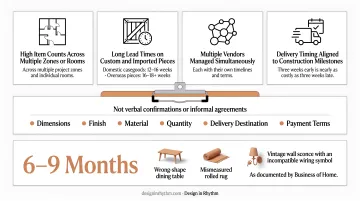
That coordination requires formal documentation. Professional procurement runs on purchase orders specifying dimensions, finish, material, quantity, delivery destination, and payment terms — not verbal confirmations or informal agreements.
Business of Home documented a residential case where a client waited 6–9 months for custom pieces, only to receive a wrong-shape dining table, incorrectly measured rugs, and vintage sconces incompatible with the wiring — a single specification error compounding across an entire installation.
What the Procurement Process Actually Involves
Procurement is not a single event — it's a sequence of phases, each with its own responsibilities. A skilled procurement team is managing dozens of moving pieces at any given moment.
Sourcing and Vendor Selection
Once designs are approved, the procurement team identifies the best vendors, artisans, or custom makers for each item — balancing quality, lead time, price, and availability. Experienced firms draw on established trade relationships rather than starting from scratch, which provides access to better pricing, priority service, and makers that simply aren't available to the general public.
At Design in Rhythm, this phase is guided by an exclusive vendor network built over more than a decade — spanning premium furniture brands, artisan workshops, custom furniture makers, lighting suppliers, and rug and accessory curators. Procurement & Logistics Manager David Chen oversees this network, tapping into trade-only relationships that most clients — and many design firms — cannot access independently.
Order Placement and Purchase Orders
Every item is ordered via a formal purchase order specifying exact product details alongside delivery destination and payment terms. Accuracy here is critical. Errors cascade downstream into delays, costly reorders, and installation complications.
Tracking and Production Monitoring
Orders placed doesn't mean the work pauses. A dedicated procurement manager monitors:
- Production progress across all vendors
- Shifting lead times and factory updates
- Shipping schedules and freight status
- Installation timeline adjustments when delays emerge
The goal is that clients are never blindsided by a problem they didn't know existed.
Receiving, Inspection, and Storage
Most items are delivered to a receiving warehouse before installation day. There, each piece is:
- Checked against the original purchase order
- Inspected for damage or defects
- Photographed and documented
Problems found at the warehouse are far less disruptive than problems discovered on installation day when trades are already on-site and timelines are tight.
Damage Management and Resolution
Freight damage happens, particularly for custom pieces traveling long distances. When it does, a procurement specialist documents it immediately, contacts the vendor or carrier, and initiates claims. From there, the fastest path to resolution — replacement, repair, or a temporary solution — is determined without losing sight of the project timeline.
Why Procurement Can Make or Break Your Project
When procurement is well-managed, the finished space reflects the original design intent. When it's mismanaged, even a beautifully designed project can finish late, over budget, and with compromised results.
The failures compound quickly:
- A delayed shipment pushes the installation date
- A missed installation window disrupts construction sequencing
- Rush replacement orders cost more, often 20–40% above spec pricing, and may not match the original specification
- A hotel's opening date shifts; a homeowner's move-in gets pushed
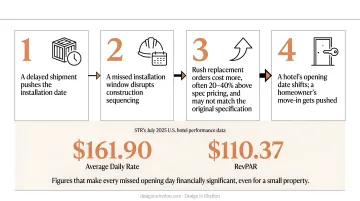
For boutique hospitality clients, that delay has a direct revenue consequence. STR's July 2025 U.S. hotel performance data shows average daily rates of $161.90 and RevPAR of $110.37 — figures that make every missed opening day financially significant, even for a small property.
The Design Integrity Risk
Delays and overruns hit the budget. The harder loss is a finished space that doesn't look the way it was designed to look.
Substitutions made under pressure, damaged pieces installed because there's no time to reorder, or pieces ordered in the wrong finish can permanently compromise the design vision. The client paid for a specific outcome. They didn't get it.
This is why Design in Rhythm sources every product before creating renderings. Clients aren't approving approximations or concept furniture — they're approving photorealistic representations of the actual items that will be ordered and installed. That means no surprises when the truck pulls up on installation day.
Trade Access: Why Your Designer's Vendor Network Matters
Many of the finest furniture makers, fabric houses, lighting designers, and artisans sell exclusively through credentialed design professionals — not through retail or public-facing channels. Architectural Digest notes that "to the trade" access provides both exclusive products and priority service unavailable through ordinary consumer channels.
A designer's trade relationships are therefore a direct upgrade to the quality and uniqueness of what ends up in a client's space.
What Trade Access Actually Provides
- Exclusive products not sold through any retail channel
- Priority scheduling from vendors who know the firm by name
- Early access to new collections before they're widely available
- Faster problem resolution when issues arise, backed by an existing relationship rather than a cold call
- Better pricing through established net-cost structures
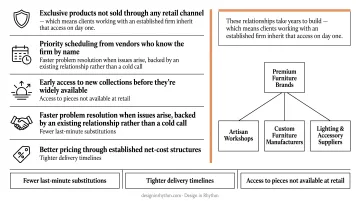
These relationships take years to build — which means clients working with an established firm inherit that access on day one. At Design in Rhythm, David Chen manages a vendor network developed over more than a decade of active project work: premium furniture brands, artisan workshops, custom furniture manufacturers capable of producing commercial-grade pieces with residential comfort, and curated lighting and accessory suppliers.
For a boutique hotel operator or residential client, this matters in concrete ways: fewer last-minute substitutions, tighter delivery timelines, and access to pieces that simply aren't available at retail — no matter the budget.
What to Look for in a Full-Service Design Firm
Not all design firms approach procurement the same way. When evaluating a firm, look for these specific markers:
- A dedicated procurement specialist — not just a designer doubling up between creative and operational work
- Documented purchase order processes — formal specifications, not informal orders
- An established vendor network — trade relationships built over years, not a retail shopping list
- Warehouse and logistics coordination — receiving, inspection, and staged delivery as standard practice
- Clear accountability from order placement through final installation
One differentiator separates firms that truly integrate procurement from those that don't — and it comes down to when sourcing happens.
The Sourcing-Before-Rendering Standard
The most meaningful test is whether a firm confirms actual product availability before creating renderings.
Conventional firms design first and source second. What you approve in a presentation may not be available, may carry a different lead time, or may require a substitution before it ever gets ordered.
Design in Rhythm works the opposite way: every product is confirmed and sourced before renderings are created. Clients see their exact furniture, finishes, and fixtures in photorealistic 3D — what you approve is precisely what arrives on site.
Questions to Ask Before Signing
Before engaging any design firm, ask:
- Does your team include a dedicated procurement manager?
- How do you handle items that arrive damaged or incorrect?
- Can you confirm product availability before showing me a rendering?
- Who is my single point of contact from design through delivery?
The answers will tell you quickly whether the firm treats procurement as a core service or an afterthought.
Frequently Asked Questions
What is procurement in interior design?
Procurement is the full process of sourcing, purchasing, tracking, and delivering every item in a design project — furniture, lighting, custom pieces, and finishing materials. It's a structured phase distinct from creative design, and it directly determines whether the finished space matches the original vision.
How much do interior designers charge for procurement?
Procurement fees vary by firm and project scope. ASID's contract framework permits fixed fees, hourly rates, and percentage-of-goods models — no universal standard applies. The fee reflects specialist labor, vendor relationships, and the risk management the firm provides on your behalf.
Can I purchase items myself instead of going through my designer?
Most full-service firms strongly advise against it. Client-purchased items often arrive at the wrong time, in the wrong specification, or without recourse if damaged — creating coordination and liability complications the design team has to absorb. Keeping procurement within the firm protects both the timeline and the design intent.
What is FF&E and why does it matter in procurement?
FF&E stands for Furniture, Fixtures, and Equipment — the core category of items procured in most interior design projects. For hospitality projects, this extends to OS&E (Operating Supplies and Equipment), adding linens, service equipment, and operational items that expand the coordination scope considerably.
How long does the procurement phase typically take?
It depends heavily on project scope, the number of custom pieces, and vendor lead times. Custom hotel furniture can take 12–20 weeks from design approval to delivery, with overseas casegoods and outdoor furniture often running longer. Starting procurement as early as possible in the project lifecycle is critical to meeting installation and opening dates.
What happens if something arrives damaged or isn't what was ordered?
A professional procurement team documents damage at warehouse receipt, contacts vendors or carriers to initiate claims, and determines the fastest resolution — replacement, repair, or an on-site remedy. Inspection happens before installation day so nothing derails the schedule when it matters most.