Introduction
New York's storefronts are having a moment. More than 40,000 new storefront businesses have opened citywide since the pandemic began. Roughly one in three currently operating storefronts is new, according to the NYC Department of City Planning's 2024 storefront report.
Restaurants make up a huge slice of that wave.
With so many new rooms chasing the same diners, interior design has become one of the sharpest competitive tools an owner has. Walk into Coqodaq, Oiji Mi, or San Sabino and it's obvious: nothing about these spaces is generic.
Studios like Rockwell Group and GRT Architects are building rooms around cultural storytelling and historic reference, layering in bold materials instead of safe, forgettable backdrops.
This guide breaks down the NYC restaurants setting the design standard, the trends shaping them, what's driving the shift, and how restaurateurs can apply these lessons with the right design partner.
TL;DR: Key Takeaways
- NYC restaurants favor cultural specificity and nostalgic charm over sterile minimalism
- Coqodaq, Oiji Mi, and San Sabino prove storytelling design keeps guests seated and sharing longer
- Five key trends: nostalgic revival, cultural storytelling, warm minimalism, maximalist color, raw-refined texture
- Rising rents and tighter footprints push designers toward intimate, detail-rich rooms
- An integrated design-procurement partner closes gaps between renderings and reality
Inspiring NYC Restaurant Interiors Setting the Design Standard
Before covering broader trends, these are the specific rooms already earning design-world acclaim and diner loyalty.
Coqodaq: A Cathedral for Fried Chicken
Rockwell Group's Coqodaq opened in the Flatiron District in January 2024, and it treats Korean fried chicken like fine dining. Illuminated cast-glass "ghost arches" soar overhead.
Walnut booths wear green upholstery, and crackled plaster walls echo the texture of fried chicken skin. Even the handwashing station, cut from green soapstone, gets ceremonial treatment.
Why it matters: Coqodaq shows how theatrical, large-scale design turns a casual cuisine into a full destination-dining experience. The room tells the story before the food arrives.
San Sabino & Cucina Alba: Yellow Rooms in Historic Shells
GRT Architects' San Sabino, tucked into a narrow West Village storefront, wraps guests in buttery yellow walls, ribbed leather banquettes, and custom light boxes. The team removed part of a foot-thick brick wall and replaced it with a stainless-steel ribbon that visually links the bar to the dining room.
Across town at Cucina Alba in Chelsea, GRT's earlier project drapes its ceiling in sunny, parachute-like fabric over quartered white oak and sandy terrazzo floors.
Why it matters: Both spaces prove narrow NYC footprints don't need to feel cramped. Color and texture, layered inside century-old buildings, build intimacy instead of limitation.
Oiji Mi: Korean Heritage as the Blueprint
AvroKO built Oiji Mi's Flatiron dining room around Korean hanok architecture — interlocking timber beams, warm wooden flooring, and lighting fixtures modeled on traditional Korean hairpins. Layered against those references are nods to Gilded Age social clubs, a deliberate collision of two histories in one room.
Why it matters: Oiji Mi treats cultural narrative as the foundation of the design, not a finishing touch. Every material choice ties back to a specific place and story.
Bar Americano & Cafe Mars: Brooklyn's Raw-Meets-Refined Playbook
Space Exploration Design's Bar Americano in Greenpoint pairs exposed brick and a white tin ceiling with tambour panels and fluted-glass dividers, anchored by a mahogany U-shaped bar.
A few miles south in Gowanus, Format Architecture Office's Cafe Mars occupies a former pasta factory, layering Memphis Milano-inspired color, hot-pink zigzag stool legs, and color-changing LEDs against the original raw shell.
Why it matters: Brooklyn keeps reinventing industrial buildings, pairing raw materials with polished, unexpected finishes rather than hiding them.
Top Restaurant Interior Design Trends Shaping NYC
Across these acclaimed rooms, and dozens more opening throughout the five boroughs, five distinct design patterns keep resurfacing.
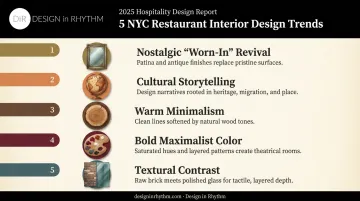
Trend 1: Nostalgic "Worn-In" Revival
Designers are intentionally aging new spaces so they feel lived-in from day one, using textured plaster, vintage mirrors, and hand-aged brass instead of anything that reads brand new. The Wren's 2024 Bowery renovation leaned into dark wood, black wainscoting, and velvet upholstery around a marble bar. Smith & Mills at Rockefeller Center went further into Art Deco territory, entering guests through a vintage elevator panel toward oxblood banquettes and a zinc-and-walnut oval bar.
Consumer research firm Mintel has flagged this pattern in post-pandemic hospitality broadly, tying it to a desire for comfort and playfulness over sterile newness. Diners want a room that feels like it has history, even when it opened last month.
Trend 2: Cultural Storytelling as the Core Concept
Interiors are increasingly built entirely around one specific cultural narrative instead of a generic "nice ambiance." Oiji Mi's hanok references are one example. Moono, designed by Two Point Zero and a 2024 NYCxDESIGN Award winner, is another — its interior features hand-painted minhwa, or Korean folk-art motifs, intended to evoke a very specific sense of Korean-American nostalgia.
This works because NYC's culinary scene rewards specificity. Guests recognize and share these narratives on social media, extending marketing reach without a paid campaign behind it. That specificity also carries into staff training, so servers can explain the story guests are seeing.
Trend 3: Warm Minimalism in Fine Dining
Some of the city's most talked-about tasting-menu rooms are pulling back rather than piling on. Palettes built from walnut, sand, and stone let the food and the conversation lead. Eleven Madison Park is often cited in design circles for exactly this kind of restraint, favoring soft, pared-back materials over anything ostentatious.
As tasting-menu fine dining expands across Manhattan, restraint has become its own signal of sophistication. Lighting typically stays low and warm, reinforcing the same quiet confidence rather than competing for attention.
Trend 4: Bold Maximalist Color & Pattern
At the opposite end sits saturated, unexpected color and pattern-heavy detailing built for energetic, photogenic rooms. Cafe Mars is the clearest local example, but it's echoed across Chinatown's dim sum halls, which layer red and gold to different but equally memorable effect.
Colorful, pattern-heavy rooms simply photograph better, and that matters more than ever given how many diners decide where to eat based on images of the room itself, not just the plate. Custom murals and statement lighting fixtures reinforce the same energetic, share-worthy mood throughout the room.
Trend 5: Textural Contrast Between Raw and Refined
The last trend pairs untouched industrial materials, such as brick, plaster, and tin, with polished finishes like brass, leather, or glass. Bar Americano's fluted glass against exposed brick is a clean example. San Sabino's partial brick removal, opening the space while keeping its historic bones visible, is another.
This juxtaposition respects the city's older building stock while still signaling contemporary investment, a balance landlords and landmark boards increasingly expect. The same logic extends to lighting and hardware, where blackened steel or brass fixtures punctuate raw surfaces.
What's Driving These NYC Restaurant Design Trends
A few concrete forces sit behind this shift in the hospitality market.
- Rising commercial rents push owners toward smaller, detail-dense spaces. Ground-floor rents on Upper Fifth Avenue averaged $2,550 per square foot in late 2025, compared to $861 on Madison Avenue, according to REBNY's Manhattan Retail Report.
- Social media virality rewards photographable, narrative-rich rooms over generic templates that look the same in every borough.
- Post-pandemic diner psychology favors comfort, nostalgia, and a sense of belonging over sterile, high-concept newness.
- NYC's increasingly diverse culinary talent is demanding design that reflects real cultural specificity rather than borrowed, generic aesthetics.
How These Design Trends Impact Your Restaurant's Bottom Line
Well-executed interior design ties to measurable business outcomes, not just aesthetics.
Guest Experience, Dwell Time & Brand Value
A 2024 field experiment tracking 282 dining parties found that slower background music stretched average dining time to 80.3 minutes, versus 57.3 minutes with fast tempo music, a 40% difference. The same study found bills and tips didn't rise significantly alongside the longer stay.
The takeaway: ambiance shapes how long guests linger. It doesn't automatically translate to higher spend, so owners should plan turnover and revenue as two separate metrics.
Design also pays off through brand value. Design-forward restaurants tend to earn stronger press and command premium pricing. Resy's "Most Magical Dining Rooms" guide, which has featured spots like Cafe Carmellini and Moono, functions as free editorial exposure. It doesn't guarantee reservations, but it puts a room in front of exactly the diners most likely to book.
Execution Risk & Why the Right Partner Matters
Here's what most first-time restaurateurs underestimate: vendor coordination and custom fabrication timelines. A gorgeous rendering means nothing if the sourced furniture takes four extra months to arrive, or the finish that looked perfect on screen doesn't match once it's installed.
Firms with an integrated design-and-procurement model close that gap. Design in Rhythm, for example, sources every product before creating a single rendering, so what a client approves is an exact representation of the materials, furniture, and finishes going into the room, not an approximation. Products are then received, inspected, and warehoused until the space is ready, with deliveries staged in the correct order for installation.
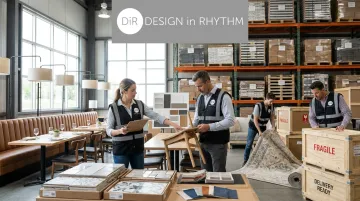
This kind of discipline applies whether the address is a Hollywood lounge like Dragonfly, a Las Vegas destination like St Felix, a theater bar in Boston, or a buzzy dining room in Manhattan. It's the same underlying problem, wherever the restaurant sits: owners need to see exactly what will be built before they commit budget to it.
Future Signals: What's Next for NYC Restaurant Design
Trends keep evolving. Here's what's worth watching in the coming years:
- Hyper-local storytelling will intensify as competition between nearby restaurants pushes owners toward increasingly specific, neighborhood-rooted narratives rather than broad cultural gestures.
- Kinetic and analog design elements (think mechanical details, vintage hardware, tactile finishes) will keep blending nostalgia with genuine function.
- Adaptive reuse of historic buildings will shape more material choices as landmark preservation rules continue to tighten around what owners can and can't alter.
NYC's most successful restaurants treat interior design as inseparable from brand and guest experience, not an afterthought bolted on before opening night. Working with an experienced hospitality design partner is what turns these trends into a space that's authentically the owner's, rather than a copy of someone else's vision.
Frequently Asked Questions
What is the most popular restaurant interior design style in NYC right now?
There isn't one dominant style. The strongest rooms blend nostalgic, worn-in materials with a specific cultural narrative, while high-end fine dining leans toward warm, pared-back minimalism instead of ornate maximalism.
How much does it cost to design a restaurant interior in NYC?
Costs vary widely depending on square footage, finish level, and how much custom fabrication is involved. A hospitality designer can give an accurate estimate once they understand your specific scope and vision.
How long does a restaurant interior design project typically take in NYC?
Full projects generally run from initial concept through installation over several months, with permitting and custom fabrication often driving the biggest swings in timeline. Heavy custom fabrication or a full liquor license buildout can add several extra months to that window.
Why is interior design important for a restaurant's success?
Interior design shapes how long guests stay, whether they return, and whether they share the space on social media. A well-designed room builds brand identity as strongly as the menu does.
Which NYC restaurants are known for exceptional interior design?
Coqodaq, Oiji Mi, San Sabino, and Cafe Mars are frequently cited by design press for interiors built around strong concepts rather than generic decor.
Should I hire a restaurant-specific interior designer or a general residential designer?
Hospitality design demands specialized knowledge of guest flow, commercial-grade durability, and code compliance that residential design doesn't require. Working with a firm experienced in restaurant and bar projects reduces risk considerably.