
Confusion about this structure leads to two predictable problems: sticker shock mid-project, or underbudgeting that forces painful compromises once work is underway. Neither is inevitable with the right information upfront.
This guide breaks down real pricing tiers, the most common fee models, what drives costs up or down, and the line items most clients never see coming — so you can size your budget to what your project actually requires.
Key Takeaways
- Fees range from a few hundred dollars for a consultation to $500,000+ for a full-scale renovation with furnishings
- The design fee is typically a fraction of total project spend — furnishings and logistics are often larger line items
- Scope, designer experience, location, and sourcing approach drive the biggest price swings
- Full-service design often costs less on furnishings than buying retail, thanks to trade access
- Matching your budget to actual project scope — not a generic estimate — is what determines whether a designer delivers real value
How Much Does an Interior Designer Cost?
There is no fixed price for interior design. Quoting a single number without knowing scope, service level, and location is misleading — and why first proposals often catch clients off guard.
Two mistakes show up repeatedly: focusing only on the hourly rate while ignoring total project scope, and underbudgeting for furnishings and logistics because those costs weren't discussed upfront.
Pricing by Project Type
The table below reflects approximate all-in ranges — design fee plus furnishings and materials — based on current market data. These are not design fees alone.
| Project Type | Approximate All-In Range | Typical Timeline |
|---|---|---|
| Single-room refresh | $2,000 – $15,000 | 4–12 weeks |
| Multi-room redesign | $15,000 – $75,000 | 3–6 months |
| Full-home renovation (no construction) | $50,000 – $200,000+ | 4–8 months |
| Full-home renovation (with construction) | $150,000 – $500,000+ | 6–18 months |
| Hospitality/commercial | $100,000 – $1M+ | 6–24 months |
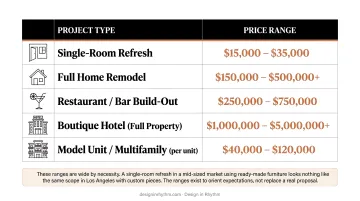
Important caveat: These ranges are wide by necessity. A single-room refresh in a mid-sized market using ready-made furniture looks nothing like the same scope in Los Angeles with custom pieces. The ranges exist to orient expectations, not replace a real proposal.
How Interior Designers Charge: Common Fee Models
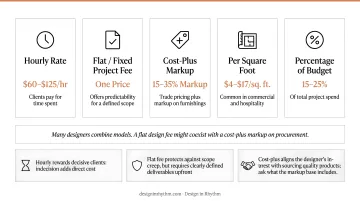
According to Thumbtack's 2025 marketplace data, the five most common models are:
- Hourly rate — $60–$125/hour nationally; clients pay for time spent
- Flat/fixed project fee — one price for a defined scope; offers predictability
- Cost-plus markup — designer charges trade pricing plus a 15–35% markup on furnishings
- Per square foot — $4–$17/sq. ft.; common in commercial and hospitality
- Percentage of project budget — typically 15–25% of total spend
Many designers combine models. A flat design fee might coexist with a cost-plus markup on procurement. Comparing headline rates across firms without reading the full proposal often produces a false picture of cost.
The model affects more than price. Each structure creates different incentives:
- Hourly rewards decisive clients — indecision adds direct cost
- Flat fee protects against scope creep, but requires clearly defined deliverables upfront
- Cost-plus aligns the designer's interest with sourcing quality products; ask what the markup base includes
Key Factors That Affect Interior Designer Fees
The same project scope can cost vastly different amounts depending on a handful of variables. Understanding these helps clients ask sharper questions before signing anything.
Scope and Number of Rooms
Scope is the single largest cost driver. A single-room refresh, a full-home gut renovation, and a boutique hotel build-out are fundamentally different engagements in terms of time, coordination, and vendor management, even when they share similar aesthetic goals.
Some designers have project minimums and won't take on single-room work. A Business of Home survey of more than 900 firms found 80% used hourly or hourly-plus-markup billing — meaning the more rooms involved, the more hours logged, the higher the design fee.
Designer Experience and Market Location
An emerging designer in a mid-sized city may charge $60–$75/hour. An established principal in Los Angeles, New York, or Boston can bill $150–$300/hour or more, not counting the firm's overhead, vendor relationships, and project management infrastructure.
That said, rate alone doesn't determine fit. Portfolio alignment with your project type matters more. A hospitality-focused firm with deep vendor relationships brings different value to a boutique hotel renovation than a residential generalist would — regardless of what either charges per hour.
Sourcing Approach: Ready-Made vs. Custom
Product sourcing shapes total project cost more than most clients expect, regardless of which fee model is in play.
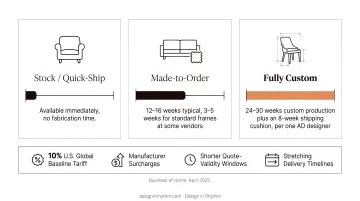
- Stock/quick-ship items — available immediately, no fabrication time
- Made-to-order — 12–16 weeks typical; some vendors 3–5 weeks for standard frames
- Fully custom — one AD designer reported 24–30 weeks for custom production plus an 8-week shipping cushion
In 2025–2026, the picture has gotten more complicated. Business of Home's April 2025 reporting documented a 10% U.S. global baseline tariff, manufacturer surcharges, shorter quote-validity windows, and stretching delivery timelines — all of which affect projects relying on custom or internationally sourced pieces. Clients should ask their designer how these variables are handled in the proposal and what contingency is built in.
Level of Service
The cost spectrum runs from a one-time consultation at the low end through full-service end-to-end management at the high end:
| Service Level | What's Included | Who Handles Execution |
|---|---|---|
| Consultation only | Advice, direction, recommendations | Client |
| Design plan only | Concept, floor plans, product list | Client |
| Full-service | Concept through installation | Designer |
The tradeoff is time and decision fatigue versus investment. Full-service design costs more upfront — but the client isn't managing vendors, tracking shipments, or coordinating contractors.
Location and Market Norms
Geography affects fees independently of designer experience. The same scope of work in Los Angeles or Washington DC can cost two to three times more than in a smaller market, due to overhead, labor rates, and local market norms. Design in Rhythm operates across Los Angeles, Las Vegas, Boston, Washington DC, and New Jersey, and proposals reflect what each of those markets actually costs to execute in.
The Hidden Costs Most People Overlook
The design fee is one of four or five costs that make up total project spend. The line items below are where clients consistently get caught off guard.
Furnishings, Materials, and Finishes
Furnishings are typically the largest single cost in any design project — and they're entirely separate from the design fee. On a full-home project, the furnishings budget can easily exceed the design fee by a factor of two or three.
Ask for a furnishings budget estimate early. Don't assume it's included in the design fee quote.
Trade Access and What It Actually Means for Your Budget
Interior designers have access to "to the trade" vendors — exclusive brands, artisan workshops, and custom manufacturers unavailable through standard retail channels. This matters for budget in two directions.
According to Architectural Digest's reporting on trade programs, vendor discounts can run 10–20% depending on brand and tier. Designers typically mark up trade pricing by 15–35% — but clients often still pay the same or less than retail while gaining access to products they couldn't source independently.
Design in Rhythm's sourcing network — built over more than a decade — spans furniture makers, artisan workshops, and custom manufacturers that clients can't reach through mainstream retailers. Procurement & Logistics Manager David Chen tracks every order from placement to delivery. The firm also sources every product before creating renderings, so what clients see in visualizations is exactly what gets installed.
That said, strict trade-only access is gradually eroding as more brands sell direct. The value increasingly lies in service, product availability, and vendor accountability when something goes wrong.
Shipping, Logistics, and Installation
Shipping and logistics are billed separately from the design fee — and on custom, imported, or multi-vendor projects, they can be a substantial line item.
Installation (coordinating staging, delivery sequencing, and placement) adds further cost. Design in Rhythm's approach holds all products in warehouse until the space is ready, then delivers and installs everything in sequence — rather than shipping items piecemeal as they arrive. This prevents the common failure mode of furniture sitting in an unfinished space. Ask any designer upfront whether this is included or billed separately.
Procurement Timeline and Its Cost Implications
Extended timelines mean higher costs on hourly or retainer arrangements, plus warehousing fees when items accumulate before a scheduled install. With 2025 tariffs compressing quote-validity windows, a price locked in month one may not hold by month four.
Before signing, ask:
- What's the designer's typical sourcing mix (stock, made-to-order, custom)?
- How are custom lead times communicated and managed?
- Are warehousing costs billed separately?
- What contingency is built into the procurement budget for delays?
Low-Cost vs. Full-Service Design: What's the Difference?
A low-cost designer and a full-service firm can both produce beautiful spaces. What the client is buying is different — and so are the risks.
| Dimension | Low-Cost / Plan-Only | Full-Service |
|---|---|---|
| What's included | Design plan, product recommendations | Concept through installation |
| Sourcing access | Retail and mass-market vendors | Exclusive trade network |
| Project accountability | Client manages vendors and execution | Single point of contact, kickoff to walkthrough |
| Risk if something goes wrong | Client absorbs it | Designer absorbs and resolves it |
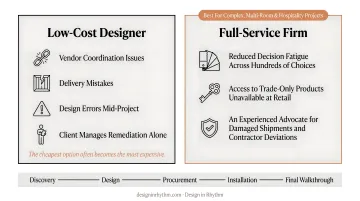
The cheapest option often becomes the most expensive when vendor coordination issues, delivery mistakes, or design errors surface mid-project. At that point, the client is managing the remediation themselves.
Full-service design earns its cost most clearly on complex, multi-room, or hospitality projects — where the number of decisions, vendors, and potential failure points is large. On those projects, clients get:
- Reduced decision fatigue across hundreds of product and finish choices
- Access to trade-only products unavailable at retail
- An experienced advocate when a shipment arrives damaged or a contractor deviates from the spec
Design in Rhythm operates this way from day one. One point of contact stays with every project — from the initial discovery conversation through the final walkthrough — and the same team that designed the space handles procurement, vendor coordination, and installation.
How to Estimate the Right Budget for Your Project
The right budget isn't the lowest available. It's the one sized to what the project actually requires, with room for the unexpected.
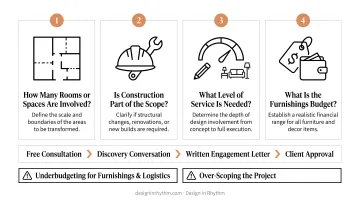
Before setting a number, answer these four questions:
- How many rooms or spaces are involved? Scope is the primary cost driver — be specific about what's included and what isn't.
- Is construction or structural work part of the scope? Construction adds cost, timeline, and coordination complexity that design-only projects don't carry.
- What level of service is needed? Design plan only, or full-service from concept to installation? The answer changes the total significantly.
- What is the furnishings budget, separate from the design fee? This number needs to exist before scope is finalized, not after.
Clients who plan to incorporate existing pieces should communicate this upfront — it can noticeably reduce the furnishings budget and total spend.
A structured discovery process is where these questions get answered before any scope is committed. Design in Rhythm's Dream Phase starts with a free in-depth consultation covering how the space will be used, who occupies it, and what practical considerations affect product selection.
At the end of that discovery, clients receive a written engagement letter outlining the articulated vision, proposed timeline, and estimated costs. The project doesn't move forward until the client approves that document — which means no surprises once work begins.
Even a single discovery conversation with a qualified firm can prevent the two most common budgeting mistakes: underbudgeting for furnishings and logistics, and over-scoping a project beyond what the budget can support.
Frequently Asked Questions
Is it worth paying for an interior designer?
For complex, multi-room, or long-term spaces, a professional designer typically saves money through trade access, fewer costly mistakes, and better sourcing decisions. Beyond cost, the bigger return for most clients is time: a full-service engagement removes hundreds of individual decisions from their plate.
How do interior designers typically charge for their services?
The five main pricing models are:
- Hourly rate — $60–$125/hour nationally
- Flat project fee — fixed price for defined scope
- Cost-plus markup — 15–35% on furnishings and sourcing
- Per square foot — $4–$17, most common in commercial work
- Percentage of budget — 15–25% of total project cost
Most designers combine these approaches depending on project scope.
What is the difference between an interior designer and an interior decorator?
Interior designers are typically trained to handle space planning, architectural elements, code compliance, and full project coordination. Interior decorators focus on furnishings, finishes, and aesthetics. CIDQ defines interior design as a distinct profession protecting health, safety, and welfare — the distinction affects both scope and cost.
What is included in a full-service interior design package?
Full-service design covers concept development, space planning, sourcing, procurement, logistics coordination, contractor communication, and installation. This is distinct from a design-plan-only service, where the client handles execution. Firms like Design in Rhythm manage the entire process under one team, from initial concept through final installation.
What are the common interior design rules (3-5-7, 70/30, 80/20)?
The 3-5-7 rule guides grouping objects in odd numbers for visual balance; the 70/30 rule suggests 70% dominant scheme and 30% contrast; the 80/20 rule recommends 80% neutral/timeless pieces and 20% trend-driven elements. Professional designers apply these instinctively as starting points, adjusting based on the specific space and client goals.
What is a realistic minimum budget to hire an interior designer?
For a single room with full design and furnishings, budgets typically start around $2,000–$15,000 all-in. Full-scope multi-room projects generally start at $25,000+. Below these thresholds, a virtual consultation is often the most effective entry point before committing to a full engagement.