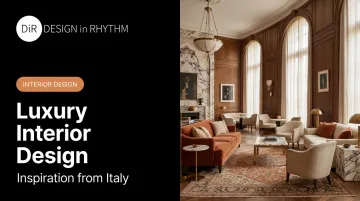
Many homeowners and hoteliers try to recreate that magic with catalog sofas, faux-fresco walls, and terracotta everything. The result usually reads as themed, not luxurious. Real Italian design isn't a costume.
This guide breaks down what actually defines Italian luxury interiors, how to apply it room by room, where the aesthetic legacy comes from, and how to translate it authentically into a US home or hospitality project.
Key Takeaways
- Italian design fuses historic craftsmanship with modern innovation, not one fixed look
- Marble, walnut, silk, and velvet layer over neutral, light-driven palettes
- Every piece earns its place in a curated, uncluttered philosophy
- Authentic results require trade access to top Italian artisans and integrated project management
The Defining Elements of Italian Luxury Interior Design
Italian design balances classical architecture with modern sensibility, generation after generation, rather than following one single style. A Roman apartment with Baroque bones and a Milanese loft with industrial steel can both feel unmistakably Italian.
Craftsmanship and Quality Materials
Italy's furniture and design sector produced €27.7 billion in turnover in 2025, with €14.2 billion in exports, according to FederlegnoArredo's 2025 industry data. That scale reflects consistent material standards upheld across ateliers and manufacturers alike.
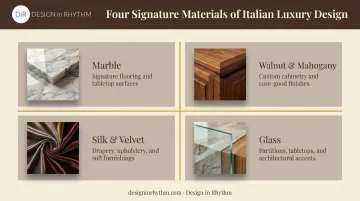
Signature materials include:
- Marble for flooring, tabletops, and bathroom surfaces
- Walnut and mahogany for cabinetry, tables, and architectural millwork
- Silk and velvet for upholstery and drapery, often woven using centuries-old techniques
- Glass paired with stone or wood for contrast and lightness
Rubelli, the Venetian textile house, still reproduces a pure-silk velvet pattern dated to the 15th century. That's the level of provenance genuine Italian luxury draws from.
Timeless, Neutral Color Palette
Whites, creams, and earthy tones dominate Italian interiors for a reason: they act as a canvas. Architectural details, like coffered ceilings or a hand-carved cornice, get to be the story instead of competing with bold wall color.
Light plays an equally important role. Italian rooms are designed around how sunlight moves through them, using shadow to add depth rather than flat, overhead brightness.
Art and Iconic Furnishings as Focal Points
In Italian interiors, one great chair does more work than five decent ones. Think of Cassina's Superleggera, the ultralight ash chair Gio Ponti designed in 1957 and now held in MoMA's permanent collection. Or the Maralunga sofa, which won the 1979 Compasso d'Oro for its bicycle-chain headrest mechanism.
These pieces anchor the room's design story. Every object serves that curated philosophy, supporting the narrative rather than filling empty corners for the sake of it.
Room-by-Room Inspiration: Bringing Italian Elegance Into Every Space
The same principles apply whether you're designing a living room or a boutique restaurant. Only the application changes.
Living & Entertaining Spaces
Italian living rooms favor sculptural silhouettes over boxy sofas. Expect low-slung seating, mixed textures like leather against boucle, and lighting fixtures that double as sculpture. Large windows and open floor plans maximize the natural light that Italian design depends on.
Private Retreats: Bedrooms & Baths
A statement headboard often anchors the room, upholstered in velvet or paired with a walnut frame. Layered ambient lighting, think wall sconces, a bedside lamp, and indirect cove lighting, replaces a single overhead fixture. In bathrooms, marble, brass, and wood combine to create a spa-like cocoon rather than a clinical space.
Dining & Hospitality Spaces
Statement chandeliers and mixed-material tables (think walnut paired with smoked glass or marble) turn dining rooms into destinations. Gallery-style art placement adds another layer, treating the walls like a curated collection rather than filler.
Scusa, a 250-square-meter Italian restaurant in Lisbon completed in 2024, earned a shortlist spot in the 2025 Dezeen Awards restaurant-interior category. The design reimagines an Italian dining concept through sunlit-terrace tones instead of red-checkered tablecloths. The result shows how Italian hospitality design succeeds when it reinterprets a concept rather than copying its usual visual cues.
Italy's Design Legacy: Iconic Homes, Regions, and Designers That Shaped Luxury
Understanding where Italian design actually comes from helps you avoid what's often called Tuscan kitsch, generic references with no real design pedigree behind them.
Regional influences worth knowing:
- Sardinia's Costa Smeralda enforces local-stone walls and low rooflines that preserve the coastal landscape, a rule dating back to the 1960s
- Milan's Liberty style brought Italian Art Nouveau into apartment buildings with wrought-iron balconies, floral motifs, and mosaic detailing
- Puglia's trulli are limestone dwellings built with mortarless dry-stone construction, recognized by UNESCO as a distinct regional craft
These regional traditions set the backdrop, but individual designers and manufacturers built Italy's global design reputation.
Designers and brands that still shape the industry:
| Name | Contribution |
|---|---|
| Patricia Urquiola | Cassina art director; spans product, architecture, and interiors |
| Piero Lissoni | Founder of Lissoni & Partners, working across architecture and interiors |
| Cassina | Founded 1927; credited with launching Italian industrial design |
| B&B Italia | Founded 1966; introduced cold-molded polyurethane foam to upholstery |
| Minotti | Founded 1948; grew from an artisan workshop into a global brand |
These names represent decades of documented technical and creative contribution. That's the difference between a reference with real depth and a stock photo of a Tuscan villa.
Translating Italian Luxury Into Your US Home or Hospitality Project
Here's the core challenge: genuine Italian materials, artisans, and furniture makers are typically only accessible through established trade relationships. That's why "Italian-style" pieces from mainstream retailers so often fall short on both authenticity and quality. They're inspired by the aesthetic without the sourcing to back it up.
A true Italian-inspired space should also reflect your own story, not a themed replica of someone else's villa. This is where a genuine discovery process matters. Design in Rhythm starts every project this way, uncovering how a client actually lives, cooks, and moves through a space before any design decisions get made. That discovery shapes the vision, but how that vision gets built matters just as much.
Why Sourcing Order Matters
Most design firms create renderings first and source furniture after approval. That sequence invites surprises: a fabric gets discontinued, a marble slab runs out, and suddenly the finished room doesn't match what was approved.
Design in Rhythm sources materials and furniture before finalizing renderings. What a client sees in their 3D visualization is exactly what gets built, no substitutions, no last-minute compromises.
That's possible because of an exclusive network of vendors, artisans, and custom furniture makers built over more than a decade. It gives clients access to the same caliber of sourcing that top design firms rely on but rarely make available to the public.
One Point of Contact, Start to Finish
This approach applies equally to:
- Full home remodels
- Boutique hotels under 100 rooms
- Restaurants and bars
Across markets including Los Angeles, Santa Barbara, Boston, Las Vegas, Washington DC, and New Jersey, one person manages the entire supply chain. Design in Rhythm's Procurement & Logistics Manager, David Chen, handles purchasing, contracts, delivery sequencing, and warehousing until installation day, so clients never coordinate a vendor or chase a shipment themselves.

Common Mistakes to Avoid When Designing an Italian-Inspired Space
Even well-intentioned projects go sideways with a few predictable missteps.
- Leaning on Mediterranean clichés. Excessive terracotta, faux-frescoed walls, or grapevine motifs signal theme park, not architecture-first luxury.
- Treating furniture as an afterthought. Proportion, light, and spatial flow come first; furniture fills in the story, not the plot.
- Underestimating lead times. Genuine Italian craftsmanship demands scheduling far in advance of anything off a warehouse shelf — skip that step, and the whole project stalls waiting on one chair.
Frequently Asked Questions
What materials are most associated with Italian luxury interior design?
Marble, walnut, silk, velvet, and glass are the hallmark materials, used across both classic and contemporary Italian interiors. Italian manufacturers consistently pair these materials to balance texture, warmth, and light.
How is Italian classic design different from Italian contemporary design?
Classic Italian design favors ornate detailing and traditional forms, while contemporary Italian design favors clean lines, industrial materials, and technical innovation. Both share the same underlying commitment to craftsmanship.
Can I get authentic Italian-inspired luxury design without traveling to Italy or importing everything myself?
Yes. Working with a designer who has established trade relationships makes this possible. Design in Rhythm's decade-built vendor network, for example, gives you access to authentic materials and craftsmanship without managing international sourcing yourself.
Is Italian-inspired design suitable for boutique hotels and restaurants, or just homes?
Italian design principles translate well to hospitality settings, from restaurants and bars to boutique hotels. Materiality and atmosphere directly shape how guests perceive and experience a space, whether it's a 40-room boutique hotel or a private residence.
How much does a custom Italian-inspired interior design project typically cost?
Costs vary widely based on project scope, material selections, and whether furniture is custom-built or sourced. A discovery consultation is the most accurate way to get a project-specific estimate.
How long does it take to complete an Italian luxury interior design project?
Timelines depend on project scale, but custom sourcing and artisan-made pieces generally require longer lead times than off-the-shelf furniture. Planning early for these lead times keeps the whole project on schedule.