: A Complete Guide](https://file-host.link/website/designinrhythm-t7zdvi/assets/blog-images/3d2af088-72c6-4fcb-b6d1-6382918c1533/1785181201100375_d513f60ff937435d9f3fde681bc7c455/360.webp)
The pull makes sense. Life feels loud right now, between notifications, deadlines, and endless scrolling. A 2025 SCAD survey of 524 millennial and Gen Z luxury consumers found that 94% associate quiet luxury with high-quality craftsmanship and 90% with premium materials. Home has become the place people want calm, not more stimulation.
Here's the misconception that trips up most homeowners, though: minimalist doesn't mean empty, cold, or sterile. Done well, it's the opposite. Luxury minimalism uses restraint to make quality impossible to ignore.
This guide covers what the style actually is, the elements that define it, color strategy, how to bring it home, common mistakes, and when it's worth calling in a professional.
Key Takeaways
- Luxury minimalism pairs restraint with premium materials, not bare, empty rooms
- Fewer, better pieces outperform a fully furnished but generic space
- Natural light, warm neutrals, and tactile textures keep spaces inviting, not cold
- Built-in storage and curated art keep spaces clutter-free without feeling stark
- A trusted design partner provides access to materials and makers you won't find at retail
What Is Modern Luxury Minimalist Interior Design?
Modern luxury minimalist design marries simplicity with sophistication. Clean lines still matter, but they're executed in materials that reward a closer look: honed marble, quarter-sawn oak, hand-loomed linen. Nothing about the room is bare — every object left in view has earned its spot through quality and craftsmanship.
That's a real departure from where minimalism started.
From Stark Reduction to Warm Minimalism
Minimalism's roots trace back to the Bauhaus movement (1919–1933), a functional design school that stripped away ornament in favor of geometry and industrial materials. Mies van der Rohe's "less is more" became gospel for decades of minimalist design that followed, sometimes producing rooms that felt more like galleries than homes.
Today's version corrects course. Dezeen's roundup of quiet-luxury homes from Biarritz to Stockholm centers on classic, hardwearing materials and simple neutral palettes rather than stark white boxes. Designers now reach for:
- Creamy, tonal neutrals instead of pure white
- Boucle, shearling, and raw silk for tactile warmth
- Walnut, stone, and other organic materials with visible grain and texture
Japan's wabi-sabi philosophy threads through this shift as well. It's the idea that beauty lives in restraint, age, and imperfection, not pristine uniformity. Think of a hand-thrown ceramic bowl left slightly asymmetrical, or a wood table that shows its grain instead of hiding it under lacquer.
Modern Luxury Minimalism vs. Standard Minimalism
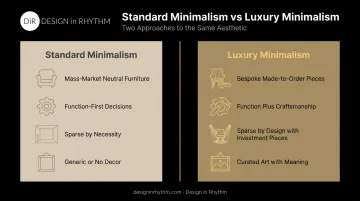
Standard minimalism and luxury minimalism start from the same place: decluttering, neutral colors, function first. Where they diverge is what fills the remaining space.
| Standard Minimalism | Luxury Minimalism |
|---|---|
| Mass-market neutral furniture | Bespoke, made-to-order pieces |
| Function-first decisions | Function plus craftsmanship and materiality |
| Sparse by necessity or budget | Sparse by design, with room for investment pieces |
| Generic decor, if any | One or two curated art pieces with real meaning |
Luxury minimalism means visual clarity: fewer objects, each chosen with real intent.
Essential Elements & Design Principles
Premium Materials and Bespoke Furniture
Marble, rich hardwoods, and fine textiles do the heavy lifting here. They catch light differently than laminate or veneer, and they feel different under your hand. That's the whole point of "understated luxury": the room reads calm from across the space, but every surface up close tells you it's real.
This is also where the quality over quantity principle shows up. A handful of expertly crafted, often bespoke pieces (a sculptural sofa, a solid-wood dining table) creates more visual impact than a fully furnished but generic room ever will. At Design in Rhythm, that often means building pieces in-house rather than sourcing them off a showroom floor, so the scale and finish match the room exactly.
Curated Lighting, Art, and Decor
In luxury minimalist rooms, natural light functions as a design material in its own right. Large or floor-to-ceiling windows do more than brighten a space. They change how every other material in the room reads throughout the day.
Statement lighting fixtures pull double duty as art. Beyond that, decor stays sparse and intentional:
- One or two art pieces that reflect the homeowner's actual story, not filler
- Fixtures chosen for form as much as function
- Empty wall space treated as a feature, not a gap to fill
Smart Storage and Natural Textures
Built-in cabinetry and concealed storage handle the practical work behind the scenes. They're what let a room stay visually clear without sacrificing everyday function; the coats, chargers, and clutter go somewhere, just not somewhere you can see.
Natural textures do the warming-up work. Linen, wool, unfinished wood, and stone keep a pared-back room from feeling cold, and they create a subtle indoor-outdoor connection that stark minimalism often misses.
Color Palettes for Luxury Minimalist Interiors
Color in luxury minimalist rooms works in layers, not flat blocks. Three approaches show up most often:
Monochromatic elegance. Varying shades, tints, and tones of a single neutral create depth without visual noise. The trick is texture: mixing smooth, matte, and nubby finishes keeps a one-color room from looking flat.
Neutral tones with a twist. Soft grays, taupes, and off-whites form the base, then get lifted with a touch of warm brass, aged bronze, or a single jewel-tone accent. The accent never dominates the palette; it adds just enough contrast to hold the eye's interest.
The power of contrast. Dark wood-toned furniture balanced against light upholstery, like soft linen, creates visual interest without breaking the calm. Black-and-white pairings work the same way when kept restrained.
For quick reference, here's how each palette approach breaks down:
| Palette Type | Best For | Key Move |
|---|---|---|
| Monochromatic | Bedrooms, small spaces | Vary texture across one tone |
| Neutral + metallic | Living rooms, dining areas | One warm metal accent, used sparingly |
| Dark-light contrast | Statement rooms, entryways | Pair dark wood with light fabric |
How to Achieve the Look in Your Own Home
You don't need a full renovation to get there. Start with what the room already gives you, then build.
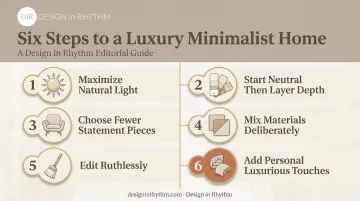
- Maximize natural light first. Use existing high ceilings and open floor plans, or introduce larger windows where the budget allows. Light is doing half the design work before you buy a single piece.
- Start neutral, then layer depth. Pick a neutral base palette for walls and flooring, then add tonal accents through furniture, art, and rugs so the room doesn't fall flat.
- Choose fewer, bigger statement pieces. A sculptural chair or large-format art piece as the room's focal point beats five smaller decorative items every time.
- Mix materials deliberately. Pair wood flooring with linen textiles and stone surfaces so the room feels warm, not sterile.
- Edit ruthlessly. Hidden storage and a disciplined approach to accessories keep the space uncluttered long-term, not just on move-in day.
- Add a few personal, luxurious touches. A cashmere throw, curated ceramics, one large indoor plant. These small details are what keep a minimalist room feeling lived-in instead of staged.
These moves scale from a single room to a full hotel lobby. Once sourcing and installation get complex, professional design support pays off.
Common Mistakes to Avoid
Even well-intentioned luxury minimalist projects go sideways in a few predictable ways:
- Overdecorating. Adding "just one more" accessory dilutes the curated feel that makes the style work. If you can't explain why an object is there, it probably shouldn't be.
- Cutting corners on furniture quality. Swapping in lower-cost pieces to save money undercuts the premium-materials foundation the entire style depends on. In a room with few objects, every flaw shows.
- Neglecting lighting design. Architectural Digest's lighting experts note that light which is too cold reads harsh and institutional, while flat, single-source lighting reads dull. Layer ambient, task, and accent lighting instead of relying on one overhead fixture.
Why Partner with a Professional Luxury Design Firm
Luxury minimalism depends on access. Premium materials, bespoke furniture makers, and skilled artisans aren't sitting on a showroom floor.
Design in Rhythm has spent over a decade building relationships with vendors, brands, and custom furniture makers, the same resources top design firms rely on. Those relationships are what make a truly curated room possible, rather than a well-styled approximation of one.
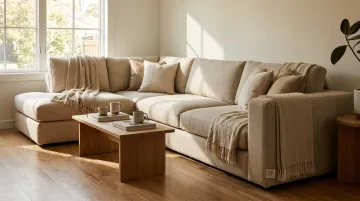
Take a real example from the firm's residential work: a client needed an oversized L-shaped sofa built to survive both kids and dogs without looking like it.
Design in Rhythm designed a custom piece for that exact brief, then followed it with a custom outdoor furniture line for the same client's backyard. The client described the result as "made for actual use, the right size, the right fabric, and incredibly durable and comfortable."
A few things that make this kind of result repeatable:
- Sourcing before rendering. The team sources products first, then builds photorealistic 3D renderings around them, so clients approve exactly what will be installed. No surprises, no last-minute swaps.
- Coordinated logistics. Nothing ships until the space is ready to receive it. The team sequences deliveries across every vendor so items arrive staged and in order, not stacked in a garage.
- One point of contact. A single team manages procurement, contractors, and installation, which removes the vendor finger-pointing that derails most DIY minimalist projects right before the finish line.
Frequently Asked Questions
What is modern minimalist interior design?
It's a style centered on clean lines, intentional simplicity, quality materials, and functional furniture, not complete emptiness. Every piece left in the room serves a clear purpose.
Is minimalism still popular in 2026?
Stark, all-white minimalism is losing ground, but restraint isn't going anywhere. Warm minimalism and quiet luxury keep the core philosophy relevant through softer, more tactile execution.
How is luxury minimalism different from standard minimalist design?
Standard minimalism focuses on decluttering and function. Luxury minimalism builds on that same foundation with bespoke furniture, premium materials, and one or two carefully chosen art pieces.
What colors work best for a luxury minimalist interior?
Monochromatic neutrals and soft greys or taupes work best, especially when elevated with a subtle metallic or jewel-tone accent. Texture matters as much as the color itself.
Is luxury minimalist interior design expensive to achieve?
It prioritizes fewer, higher-quality investment pieces over volume, which means it can scale across different budgets. The spending concentrates on select, well-chosen pieces rather than filling every corner.
How do you make a minimalist space feel warm instead of cold?
Lean on natural textures like linen, wool, and unfinished wood, plus warm neutral tones and layered ambient lighting. These elements do most of the work in keeping a pared-back room feeling cozy rather than clinical.