For boutique hotels, restaurants, and high-net-worth homeowners, this shift matters. A design that looks stunning in a photo but ages poorly, ignores guest comfort, or requires constant tech workarounds isn't a good investment. This article breaks down the five trends reshaping the industry, what's driving them, how they're changing the way design firms operate, and what to watch over the next one to three years.
Key Takeaways
- Sustainability and wellness are now baseline expectations, not extras.
- Clients want spaces built around their story, not a signature look.
- Photorealistic renderings and AR/VR previews cut costly mid-project surprises.
- Firms combining design, procurement, and logistics outperform multi-vendor setups.
Key Trends Shaping the Future of Interior Design
Five forces are reshaping residential and hospitality design across major markets right now. Some are about materials and health. Others are about technology and personal identity. Together, they're redefining what clients expect from a finished space.
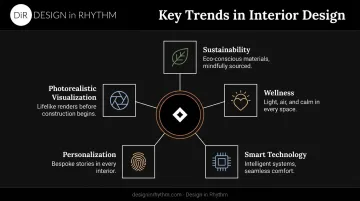
Sustainability as a Foundational Design Philosophy
Sustainability isn't a checkbox anymore. It's baked into how designers select materials, plan energy use, and think about a building's lifespan from day one.
The numbers back this up. The global green-building-materials market hit $285.9 billion in 2024 and is projected to reach $458.6 billion by 2030, an 8.5% annual growth rate according to Grand View Research. That's a construction-wide figure, but it signals where sourcing priorities are headed across the built environment, interiors included.
In practice, this looks like:
- Reclaimed and repurposed wood in millwork and custom furniture pieces
- Low-impact textiles made from organic or recycled fibers for upholstery and drapery
- Energy-conscious fixtures, such as LED systems and high-efficiency HVAC integration, specified at the design stage rather than retrofitted later
Firms with deep vendor networks have an advantage here. When a firm already has relationships with artisans and manufacturers producing FSC-certified wood or recycled-content materials, sourcing sustainably doesn't mean sacrificing the aesthetic a client wants.
Human-Centric and Wellness-Driven Spaces
Designers are increasingly treating physical and mental well-being as a design input, not an afterthought. Biophilic elements, sensory-conscious layouts, and inclusive planning are showing up in hospitality and residential projects alike.
The research here is genuinely mixed, and that's worth being honest about. A 2025 hotel study involving 428 guests found that higher-quality biophilic elements boosted perceived well-being and guest willingness to pay.
An earlier controlled study with 390 participants found no direct statistical link between biophilic elements and subjective well-being, pointing instead to delight and personal connection as the real drivers.
What this means practically:
- Natural light, greenery, and organic materials often feel better, even when the science isn't fully settled
- Accessibility-first layouts (wider pathways, adaptable furniture heights, flexible sensory zones) are increasingly standard in hospitality
- Designers are paying closer attention to acoustic comfort and tactile material choices, especially in spaces meant for rest or recovery
More property owners now understand this: how a space feels directly affects guest satisfaction and return visits.
Smart Technology and AI-Driven Automation
AI, IoT, and automation are turning static rooms into responsive environments. Lighting that adjusts to time of day, climate control that learns preferences, and voice-activated systems are moving from novelty to expectation, particularly in hospitality.
Demand is real, even if full deployment is still catching up. In a 2022 survey of 5,000 travelers, 43.6% said they wanted voice-activated control over lights, curtains, and door locks, and 25.4% wanted temperature and lighting to auto-adjust based on preferences shared before arrival.
Common applications today include:
- Voice-activated lighting and climate systems in luxury suites and high-end homes
- Preference-based automation that adjusts a room before a guest even checks in
- Predictive personalization tools that learn routines over repeat stays
This matters because AI is no longer just a marketing term in hospitality tech. It's becoming a functional layer of both space management and the initial design process itself, generating early concepts before a designer ever picks up a pen.
Hyper-Personalization and Storytelling-Led Design
Clients don't want a trending aesthetic anymore. They want a space that reflects their story. This is the biggest shift in how design firms operate: it changes the starting point of every project.
At Design in Rhythm, this plays out through what founder Jon Wheat calls the Dream Phase, a discovery conversation built around one principle: "We listen first. We design second." Instead of presenting a style menu, the team asks about daily rhythms, who actually uses the space, and what practical realities (kids, pets, high-traffic zones) need to shape the layout.
One client, Colleen R., mentioned during discovery that she wanted a giant L-shaped sectional, what she called her "monster couch," that would blend with the natural view outside her living room. The team built the entire space around that single detail, incorporating dog-proofing and kid-proofing features once her lifestyle came up in conversation.
Clients increasingly equate authentic, story-driven design with real value, and that expectation keeps growing. A 2024 McKinsey Travel Loyalty Survey found personalized service is valued 2.5 times more by Gen Z travelers than by baby boomers, a clear signal that personalization isn't a passing preference. It's generational.
Photorealistic Visualization and Virtual Collaboration
Rendering technology has closed the gap between "here's the concept" and "here's exactly what you'll get." Clients can now approve materials, furniture, and finishes in photorealistic detail before anything is purchased.
Design in Rhythm's approach flips the typical order: every product is sourced and confirmed before a single rendering is created. That means the 3D visuals clients approve aren't stylistic placeholders, they're exact representations of the actual pieces headed to their space. As the firm puts it, "What you see is what you get."
Client Royce P., who came in with just one couch idea and a few decor notes, described the impact directly: "I had a rendering of my would-be apartment before getting started, so being very picky, it was a huge relief to have that, and Jon had a solution for every last-minute curveball I came up with."
This approach is gaining traction industry-wide because remote collaboration has become the norm, and nobody wants to discover mid-installation that a discontinued fabric or backordered sofa doesn't match what was promised.
What's Driving These Trends
A mix of technology, economics, and regulation is pushing these shifts from optional to expected.
- Smarter design technology is lowering the barrier to entry, with AI tools and advanced rendering software making custom visualizations accessible to smaller firms.
- Heightened client expectations now favor personalization and sustainability—a demand driven by younger homeowners and travelers that continues to grow.
- Economic pressures from rising material and labor costs are pushing firms toward integrated models that reduce waste, vendor markups, and costly re-orders.
- Evolving regulations and standards, including building codes like the 2024 IBC and frameworks like LEED and WELL, are actively shaping what compliant design means.
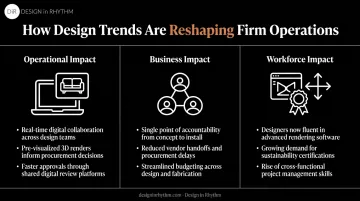
How These Trends Are Impacting the Industry
These shifts extend beyond aesthetics, reshaping how design firms operate day to day.
Operational Impact
Workflows are shifting toward digital-first collaboration. Firms are relying more heavily on pre-visualized procurement, meaning renderings, floor plans, and CAD files get client approval before a single item ships. This reduces the back-and-forth that used to happen once physical samples arrived.
Design in Rhythm sources every product before building the 3D renderings, so what a client approves on screen is exactly what shows up on-site. That upfront verification cuts approval cycles from weeks to days and removes the guesswork that used to derail installation timelines. For clients, that means fewer surprises: the fabric and finish shown in a rendering are exactly what arrives on installation day.
Business Impact
Firms are consolidating design, procurement, and logistics into one accountable team rather than outsourcing pieces to separate vendors. Design in Rhythm's model, "one team, start to finish," keeps the same point of contact from the initial discovery conversation through final installation.
That structure shows up in practical ways:
- Products are warehoused and inspected before delivery, so nothing ships until the space is ready
- Deliveries are sequenced to arrive exactly when needed, not before
- One team manages contractors, trades, and vendors simultaneously, avoiding the finger-pointing that fragmented projects often produce
Client Robert G., who worked with the firm across multiple multifamily installations, put it simply:
"Install was also a breeze, as Jon and his team are timely and professional throughout."
Workforce Impact
Designers now need skills that didn't matter much a decade ago:
- Rendering software fluency, to walk clients through spaces before they're built
- Working knowledge of sustainability certifications such as LEED or WELL
- Comfort managing cross-functional teams across design, sourcing, and installation
The role now combines creative vision with day-to-day operational management.
Future Signals to Watch
These trends will keep evolving. Here's what's worth tracking over the next one to three years:
- AI-generated concepts becoming standard practice - Mood board and mockup generators are moving from novelty to routine, speeding up client presentations and the ideation phase.
- Biomaterials entering mainstream sourcing - Mycelium-based composites are already tested as acoustic paneling alternatives. Commercial products like Mogu Fields wall panels prove the applications extend beyond lab testing.
- Hospitality and residential design blurring together - "Hotel style at home" keeps intensifying, with boutique hotel comfort increasingly setting the benchmark for high-end residential design.
Design in Rhythm's boutique hotel and residential projects already reflect this crossover, borrowing amenity-level details for homes and residential warmth for hotel lobbies.
Conclusion
Sustainability, wellness, smart technology, personalization, and precise visualization are converging into a single definition of what good design means now.
Firms and clients who adapt early, whether that's specifying low-impact materials or insisting on rendering accuracy before procurement, gain both better outcomes and fewer costly surprises. The ones who wait tend to play catch-up on client expectations that have already moved on.
That gap is exactly what strategic foresight closes. It separates a space that feels timeless in five years from one that already looks dated. At Design in Rhythm, that foresight shapes every project—from first rendering to final installation.
Frequently Asked Questions
What is the future of interior design?
The future centers on sustainability, wellness, AI-driven personalization, and immersive visualization tools. Together, these shifts make design more precise and far more attuned to how people actually live and feel in a space.
What are the 2026 interior design trends?
Expect climate-resilient materials, smart automation, hyper-personalized storytelling-driven interiors, and photorealistic pre-visualization to dominate. Clients increasingly want proof of exactly what they're getting before committing.
How is AI changing the interior design process?
AI now supports early-stage rendering, layout optimization, and predictive personalization. Designers still retain full creative and strategic oversight; AI speeds up ideation rather than replacing human judgment.
Is sustainable interior design more expensive?
Upfront costs can run higher for certified materials or energy-efficient systems. Over time, though, durability, lower energy use, and reduced waste often offset that difference, particularly on longer-term hospitality investments.
How do designers ensure a space reflects a client's personality?
A thorough discovery process is the key. Design in Rhythm's process, for example, uncovers lifestyle details, daily routines, and unspoken preferences before any design work begins, ensuring the result feels authentically the client's own.
What role does technology play in visualizing a design before installation?
Design in Rhythm sources every product before creating renderings, so photorealistic 3D visuals and AR/VR previews show exact materials and layouts, not approximations. Clients approve precisely what will arrive on-site before procurement even starts.