Introduction
That stunning boutique hotel lobby your guests can't stop posting about? It comes from hundreds of coordinated decisions made months, sometimes years, before a single guest checked in.
Behind every seamless hotel opening or renovation sits disciplined project management. Boutique hotel owners and developers often underestimate how many moving parts need to align: construction crews, designers, FF&E vendors, contractors, and staff all working on different timelines toward the same deadline.
When those pieces don't sync, the result is predictable. Delays. Budget overruns. Guests navigating around plastic sheeting and power tools.
This guide breaks down what hotel project management actually involves: the lifecycle phases, the key players, the risks that trip up even experienced owners, and the practices that separate a smooth opening from a chaotic one.
Key Takeaways
- Hotel projects must satisfy guest experience and staff operational needs simultaneously
- Five recognizable phases carry every hotel project from concept to guest-ready
- Vendor delays and guest disruption rank among the top risks in hospitality construction
- Building 10-15% schedule buffer and centralizing vendor communication prevent most overruns
- Integrated design-procurement teams eliminate the coordination gaps that derail boutique projects
What Is Hotel Project Management?
Hotel project management is the coordinated planning, procurement, and execution process that turns a concept, whether it's a new build, a full renovation, or an FF&E refresh, into a guest-ready, operational property. On time. On budget.
It differs from standard construction project management in one critical way: it has to satisfy two audiences at once.
A general contractor managing an office building cares about structural integrity and code compliance. A hotel project manager also has to think about how a guest feels walking into the lobby at 11 p.m. after a delayed flight. Housekeeping needs to move a cart through the corridor without disturbing a sleeping guest three doors down.
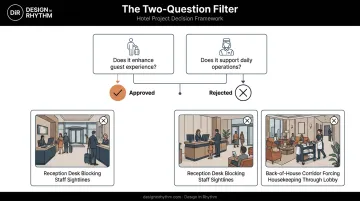
The Two-Question Filter
Every decision on a hotel project gets weighed against two questions:
- Does it enhance the guest experience?
- Does it support day-to-day hotel operations?
A gorgeous reception desk that blocks staff sightlines to the entrance fails the second test. A back-of-house corridor that's technically code-compliant but forces housekeeping to cross the lobby with linens fails the first.
Scope Varies. Discipline Shouldn't.
That same two-question filter applies no matter the project size, but the size itself changes almost everything else about how the work gets managed. Ground-up construction for a new build looks nothing like a boutique property's lobby refresh or a room-by-room renovation. The former might run 18-24 months and involve architects, structural engineers, and permitting boards. The latter might take a few weeks per floor.
What stays constant is the need for structure: a budget, a timeline, a sequence, and someone accountable for all three.
The stakes are climbing fast. The Highland Group's Mid-Year 2024 U.S. Boutique Hotel Report projected a 9% increase in branded-boutique supply, with construction heavily concentrated in urban markets. More boutique properties competing for the same guests means less room for a botched renovation or a delayed opening.
The Hotel Project Lifecycle: 5 Key Phases
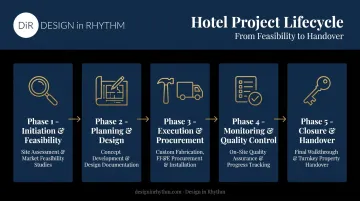
Regardless of size, hotel projects tend to move through five recognizable phases. Each has its own deliverables, and skipping ahead in any of them is usually where trouble starts.
Initiation & Feasibility
This is where the project earns its right to exist. Work here includes:
- Researching the market and mapping competitive positioning
- Running feasibility studies that weigh cost against projected revenue
- Defining the target guest segment (business traveler, weekend leisure, extended-stay)
- Setting preliminary budget parameters before any design work begins
Skip this phase, or rush it, and you risk designing a beautiful hotel nobody wants to book at your target rate.
Planning & Design
Architectural and interior design development take shape alongside permit applications and brand-standard alignment if you're working with a flag or soft brand. Early FF&E specification and vendor identification also start in this phase, not after.
Waiting until construction begins to think about furniture is one of the most common (and costly) planning mistakes.
Execution & Procurement
Construction or renovation work runs in parallel with sourcing, ordering, and staging furniture, fixtures, and equipment. The goal: materials arrive in the correct sequence, not just on time.
This is where sequencing discipline matters most. Flooring installed before millwork is finished. Furniture delivered before electrical rough-in is complete. Both create rework, both cost money.
Monitoring & Quality Control
Progress tracking against budget and timeline continues throughout, backed by regular site inspections and punch-list management. Catching a misaligned fixture or a paint mismatch during a walkthrough is far cheaper than catching it during a guest's stay.
Closure & Handover
Final walkthroughs, staff training, and documentation (warranties, as-built drawings) close out the project. This phase ends with a formal handover to hotel operations, meaning the property is no longer a construction site. It's a business.
Who's Involved: Key Roles in Hotel Project Management
Hotel projects pull together people with fundamentally different priorities. Understanding who owns what prevents finger-pointing later.
Owners, investors, and developers focus on ROI, brand compliance, and financial oversight throughout the project. They're asking: is this still on budget, and will it perform against the pro forma?
Architects, general contractors, and engineers own the structural build and building systems, HVAC, electrical, plumbing. Their job is executing what's drawn safely and to code.
Interior design and procurement partners source furniture, finishes, and custom pieces while managing logistics and delivery sequencing. This is where a lot of boutique hotel projects fall apart. Owners end up coordinating a designer, a separate procurement agent, a freight company, and an installation crew, none of whom answer to each other.
Firms like Design in Rhythm approach this differently by combining design, procurement, and logistics into one integrated team.
On the Wilshire Hotel project, for instance, the firm was brought in specifically for sourcing and procurement. Construction was already underway, so the team plugged into the existing plan rather than requiring the owner to manage a separate procurement vendor. On the Magic Castle Hotel and Hollywood Hills Hotel, that scope expanded to full design-through-installation.
Hotel operations or brand liaisons are the reality check. They ensure the finished space actually supports staff workflow, not just guest-facing aesthetics, and confirm the property meets brand experiential standards before opening day.
Common Challenges and Risks in Hotel Projects
Every hotel project faces some version of the same risks. What separates smooth deliveries from chaotic ones is how those risks get managed.
Guest Disruption During Live Renovations
Noise, dust, and restricted access during a live renovation directly threaten the guest experience you're trying to improve. Phased work zones, tackling one floor or wing at a time, combined with off-peak scheduling for the loudest work, minimize how much guests actually notice.
Vendor and Supply Chain Delays
Vendor delays are one of the most common causes of hospitality project overruns. A single late shipment of custom millwork can stall an entire floor's installation schedule.
Reducing this exposure comes down to a few practices:
- Qualifying backup suppliers before the project starts
- Building buffer time into the schedule for custom or imported pieces
- Centralizing vendor tracking under one team instead of hoping every supplier hits their promised date
Design-build firms with an in-house procurement team, like Design in Rhythm, catch these delays early instead of juggling multiple subcontractors.
Budget and Schedule Overruns
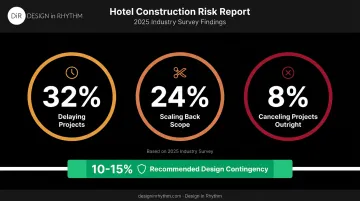
This risk is well-documented beyond hospitality, too. AHLA's August 2025 survey of 387 property owners and operators found 32% were delaying hotel projects, 24% were scaling back scope, and 8% were canceling projects outright, largely due to cost and timeline pressures.
Contingency funds help absorb this risk. Construction industry guidance from AGC's CM/GC public-owner guidelines suggests design contingency starting around 10-15% during early planning stages, tapering as scope firms up. For a boutique hotel renovation with a lot of custom sourcing, building toward the higher end of that range is rarely wasted money.
Best Practices for Successful Project Delivery
The projects that open on schedule tend to follow a similar playbook.
- Build 10-15% buffer time into vendor-dependent milestones. Assuming best-case delivery timelines is how a two-week delay becomes a two-month one.
- Centralize vendor commitments and communication history in one system. Scattered emails and spreadsheets are where accountability disappears.
- Use phased or iterative rollouts for design and FF&E changes. Test a new furniture package or finish in one room before ordering it for eighty.
- Source and confirm every product before finalizing design renderings. Design in Rhythm follows this approach on every boutique hospitality project. Owners approve renderings that match exactly what arrives on-site, because every item is sourced and confirmed before the visualization is created.
- Designate a single point of contact across design, procurement, and installation. Coordination failures happen when owners are forced to manage multiple disconnected vendors and contractors themselves, chasing updates from five different companies instead of one.
This coordination point drives on-time delivery more than any single design or construction decision. Most hotel project breakdowns trace back to communication failures: parties who were never structured to talk to each other in the first place.
Tools and Skills for Effective Hotel Project Management
The right systems and the right people make the difference between a project that runs on schedule and one that runs on hope.
Common software categories:
- Task and timeline management — Asana, Monday.com, or Microsoft Project for tracking deliverables and deadlines
- Vendor and contact tracking — CRM (customer relationship management) tools that log every commitment, lead time, and communication thread
- PMS/POS (property management and point-of-sale) integration — for scheduling room and outlet availability around active work zones
Core soft skills that matter more than any software:
- Clear cross-department communication between design, construction, and operations teams
- Adaptability when a shipment delays or a permit gets held up
- A customer-centric mindset that keeps guest impact top of mind at every decision point
Software tracks the plan. People make the plan work when reality doesn't cooperate.
Frequently Asked Questions
What does a hotel project manager do?
A hotel project manager coordinates budgets, timelines, vendors, and teams across planning, design, construction, and handover. Their job is delivering a guest-ready property without surprises along the way.
Do hotels need project managers?
Any hotel undertaking construction, renovation, or a significant FF&E (furniture, fixtures & equipment) or design refresh benefits from dedicated project management. It controls costs and keeps multiple vendors aligned toward one deadline, minimizing guest disruption along the way.
What is the biggest challenge in hotel project management?
Balancing continued guest operations with active construction or renovation work is typically the hardest part. Vendor and supply chain coordination runs a close second.
How long does a typical boutique hotel renovation take?
Duration depends heavily on scope, from a few weeks for a lobby refresh to several months for a full property renovation. Phased FF&E and design work can often proceed without shutting the property down entirely.
What's the difference between a general contractor and a hotel project manager?
A general contractor executes the physical build: framing, mechanical systems, finishes, and code compliance. A project manager, or an integrated design and procurement team, oversees the broader coordination of design, vendors, budget, and timeline across the whole project.
What software tools do hotel project managers rely on?
Common categories include task management platforms like Asana or Monday.com, PMS-integrated scheduling tools for room and outlet availability, CRM systems for tracking vendor and stakeholder communication, and procurement trackers for FF&E order status.