Too many hospitality spaces still get built around a mood board and a budget line. The result looks polished in photos but falls apart in practice: guests wait too long at check-in, servers weave through poorly planned floor layouts, and bars feel beautiful yet somehow forgettable.
This article breaks down what design thinking actually means in a hospitality context, walks through its five-stage process, and covers the frameworks teams use to structure decisions. We'll also look at how a boutique design firm applies these principles on real projects.
Key Takeaways
- Design thinking applies human-centered, iterative product design methods to guest experience strategy
- The process runs through five modes: Empathize, Define, Ideate, Prototype, and Test
- Structured frameworks help hospitality teams turn guest research into concrete design decisions
- Guest experience investment correlates with measurable performance gains, including higher ADR and RevPAR
- A specialized hospitality design partner can run this process without an in-house team
What Is Design Thinking in Hospitality?
IDEO, the firm most credited with popularizing the methodology, defines design thinking as a human-centered approach to innovation that draws on the designer's toolkit to integrate people's needs, technological possibilities, and business requirements. Notice what's missing from that definition: any mention of style, trend, or finish selection.
That's the core distinction. Traditional interior design often starts with a look, then works backward to justify it. Design thinking starts with a person, usually a guest or a staff member, and works forward toward a solution.
Why Hospitality Needs This Shift
Hotels, restaurants, and bars aren't selling a single object. They're staging an entire journey—arrival, wait, seating, service, departure—that plays out across multiple senses and touchpoints. A gorgeous check-in desk means nothing if the line behind it takes fifteen minutes to clear.
The stakes are real. In McKinsey's 2023 survey of 3,200 travelers, positive past experiences ranked as the top reason people choose a travel brand again, and for lodging specifically, "an experience worth paying more for" topped the list of loyalty drivers.
This isn't just a large-chain strategy either. The same five-stage process applies whether you're:
- Renovating a 40-room boutique hotel
- Opening a neighborhood restaurant
- Redesigning a cocktail bar's back-of-house flow
Scale changes the budget, not the methodology.
The 5-Stage Design Thinking Process for Hotels, Restaurants & Bars
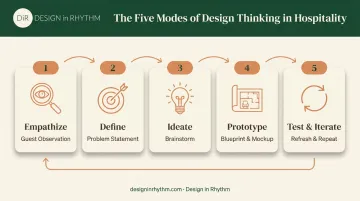
Stanford's d.school, which formalized much of this framework, describes five modes, not rigid sequential steps. Teams loop back constantly, and prototype and test often happen in tandem. Here's how each mode plays out in a hospitality setting.
Empathize
This stage means gathering guest feedback through reviews, surveys, and direct floor observation to surface both stated and unstated needs. A common example: reviewing a pattern of complaints about check-in wait times or rooms not being ready at posted times. The complaint on paper might say "slow check-in," but the underlying frustration could be something else entirely, like unclear signage sending guests to the wrong line.
Strong empathy research pulls from several sources at once:
- Guest reviews and post-stay surveys for stated complaints
- Direct floor observation during peak arrival and departure windows
- Front-line staff interviews, since employees often spot friction points guests never mention in writing
- Mystery stays or shadowing shifts to experience the guest journey firsthand
A discovery process that combines these sources tends to surface the real problem faster than survey data alone.
Define
Once the research is in, teams synthesize it into one clear, specific problem statement. This step keeps design, operations, and F&B teams aligned on the actual issue rather than three separate assumptions about what's broken.
Take the check-in complaint from the Empathize stage. Design might assume it's a layout problem, operations might assume it's a staffing shortage, and F&B might assume it's unrelated entirely. A sharper problem statement, something like "guests feel lost in their first five minutes on property," replaces three guesses with one shared target.
Ideate
With the problem defined, cross-functional teams brainstorm a wide range of solutions, from small operational tweaks (adding a self-service kiosk) to bigger swings (a redesigned arrival sequence). The goal here is volume over perfection; narrowing comes later.
For the "guests feel lost" problem statement, a brainstorm might surface options like:
- A greeter stationed near the entrance during peak arrival hours
- Clearer sightlines from the door to the front desk
- Digital wayfinding on lobby screens
- A welcome drink station that slows guests down while staff catch up
Some ideas die in the next meeting. Others move forward to Prototype.
Prototype
Ideas get tested at small scale before anyone commits real capital. That might mean a mock room layout taped out on a warehouse floor, a sample tasting menu served to staff, or a redesigned check-in flow trialed for one weekend.
The digital wayfinding idea from Ideate, for instance, could run on a single borrowed screen for a few days before anyone orders permanent hardware. Cheap failures here save expensive mistakes later.
Test & Iterate
Validated solutions roll out, guest feedback keeps coming in, and the team refines continuously. A wayfinding screen that tested well over one weekend might get repositioned after 30 days of full rollout data, then adjusted again as guest expectations shift.
Design thinking treats this as an ongoing loop, not a one-and-done renovation project.
Why Design Thinking Drives Real Business Results in Hospitality
The connection between guest experience and financial performance isn't theoretical anymore. Cornell's Nolan School modeled hotel reputation data and found that a 1% improvement in a hotel's online reputation index correlates with 0.89% higher ADR, 0.54% higher occupancy, and 1.42% higher RevPAR. That's a meaningful swing tied directly to how guests perceive their stay.
Executives have taken notice. PwC's research on hospitality technology investment found that 76% of hospitality executives rank personalizing the customer experience as a high priority for building loyalty.
Marriott's Approach at Scale
Marriott built a 10,000-square-foot Innovation Lab beneath its Bethesda headquarters to rapid-prototype guestrooms, lobbies, meeting spaces, and food-and-beverage concepts before rolling them out.
It later took the idea further with a live-hotel version. Charlotte Marriott City Center became a working lab called M Beta, testing everything from keyless entry to a front-desk-free arrival experience with real guests providing real-time feedback.
No public source discloses an exact revenue lift from this specific program, but the structure itself, testing ideas in a live environment before company-wide rollout, illustrates design thinking applied at scale.
The Competitive Edge for Independent Properties
Design thinking gives boutique properties a way to compete against chains without matching their marketing budgets. Instead of chasing a generic "modern luxury" look, independent hotels, restaurants, and bars can build something distinctly theirs, rooted in actual guest behavior rather than a trend cycle.
Skip this process and the risk is real: a renovation that photographs beautifully but doesn't match how guests actually move through the space, leaving expensive square footage underperforming.
Running this process well without a dedicated innovation team is exactly where a specialized hospitality design partner earns its keep.
Key Frameworks Behind Design Thinking in Hospitality
The Four Rules of Design Thinking
You'll sometimes hear these called the "four pillars," but the more accurate source is Plattner, Meinel, and Leifer's academic framing of four rules of design thinking:
| Rule | What it means in hospitality |
|---|---|
| Human Rule | Every decision should account for actual guest and staff behavior, not assumptions |
| Ambiguity Rule | Keep options open early; don't lock in a floor plan before testing it |
| Re-design Rule | Most hospitality problems (wait times, flow, comfort) have been solved before elsewhere; adapt, don't reinvent |
| Tangibility Rule | Physical mockups and renderings communicate ideas faster than descriptions ever could |
Translated into practice, these rules show up in space planning decisions, service protocols, and staff training. On boutique hotel projects, for example, a tangible prototype of a new greeting sequence teaches faster than any written policy could.
A Five C's Model Worth Borrowing
Where the four rules shape process, another model zeroes in on the guest experience itself: the Five C's. There's no single, universally agreed "5 C's of hospitality" framework, despite what you might find online. The most credible version comes from EHL Hospitality Business School's research on luxury travel specifically:
- Culture – local heritage shaping the guest's sense of place
- Cuisine – food as a defining experience, not an afterthought
- Community – opportunities for guests to connect socially
- Content – how the experience gets communicated and framed
- Customization – room for guests to shape their own experience
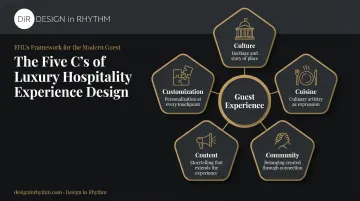
Each connects to a spatial choice. Culture might mean sourcing regional artisan furniture. Customization could mean modular seating that adapts to a solo traveler or a group of six.
How Design in Rhythm Brings Design Thinking to Life in Boutique Hospitality
Design in Rhythm's process, built over a decade of hospitality and residential work, mirrors the Empathize and Define stages almost by design. The firm's discovery phase, called Dream, starts before a single sketch happens.
During Dream, the team digs into how a space will actually be lived in, uncovering what boutique hotel, restaurant, and bar owners want even when they can't fully put it into words yet. Key questions include:
- How guests and staff will move through the space day to day
- Who uses each area, and when
- What daily rhythm the design needs to support
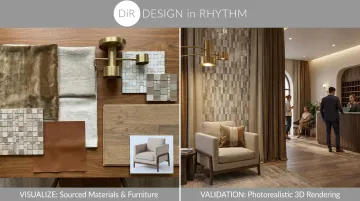
That research feeds directly into the Visualize phase, where the firm's approach diverges from typical design workflows. Every product gets sourced before the photorealistic 3D renderings are built.
That means owners aren't approving an artist's impression. They're reviewing the actual furniture, finishes, and fixtures that will arrive on-site, validating materials and layout decisions while changes are still cheap to make.
Once renderings are approved, the firm's procurement and logistics function takes over. Led by Procurement & Logistics Manager David Chen, the team handles:
- Sourcing, contracts, and vendor coordination
- Delivery sequencing and warehousing
- Trade and contractor scheduling as one unified operation
For a hotel or restaurant owner, that means moving from idea to finished space without personally chasing a shipment or mediating a contractor dispute.
Frequently Asked Questions
What is design thinking in the hospitality industry?
It's a human-centered, iterative approach to solving guest experience problems by researching real behavior first, rather than starting with aesthetics or technology alone. The goal is a space that functions as well as it looks.
What are the 4 pillars of design thinking?
More accurately called the four rules: Human, Ambiguity, Re-design, and Tangibility. In hospitality, they translate into decisions about space planning, service protocols, and staff training grounded in real guest behavior.
What are the 5 C's of hospitality?
There's no single universal framework. EHL's luxury travel model (Culture, Cuisine, Community, Content, and Customization) offers a useful lens for shaping distinct, memorable guest experiences through design.
How is design thinking different from traditional interior design?
Traditional design often starts with a visual concept and budget. Design thinking starts with guest research and a defined problem statement before any aesthetic decisions get made.
How long does it take to implement design thinking in a hospitality project?
Timelines vary by scope, but discovery and prototyping stages add structured research time upfront. That investment typically prevents far more expensive changes once construction or installation begins.
Can design thinking be applied to restaurants and bars, not just hotels?
Yes. The same five-stage process applies to any hospitality format. Restaurants and bars have guest journeys and touchpoints just like hotels do, from entry to seating to service.