2026's defining mood isn't a single aesthetic. It's a collective pivot toward spaces that feel genuinely inhabited: layered, artisanal, romantic, and deeply personal. A 2024 survey of 643 interior designers found that 81% planned to source vintage 20th-century pieces and 62% intended to prioritize artisanal over mass-produced items for the coming year—numbers that signal a real shift, not a passing mood.
From residential remodels to boutique hospitality design, these 12 trends share one thread: character over perfection, materiality over polish, meaning over matching.
Key Takeaways
- Authenticity beats staging—collected, layered rooms are replacing trend-chasing, uniform aesthetics
- Dark, characterful woods are displacing pale Scandi finishes across cabinetry, flooring, and furniture
- Earthy palettes (chocolate, ochre, dusty blue) are gaining ground as primary color stories
- Textile wall hangings, fringing, and heirloom fabrics are bringing sensory richness back to rooms
- Lacquered furniture and hand-painted tiles are pushing out safe, predictable finishes
- Defined, purpose-built rooms are making a quiet return after two decades of open floor plan dominance
Authenticity Over Algorithm: Lived-In, Human-Centered Design
The word you'll hear most from designers in 2026 is authenticity. Not as a buzzword—as a genuine design directive. Clients are tired of rooms that look staged for an audience that never arrives.
Lived-In Interiors
A lived-in aesthetic isn't about neglect. It's intentional curation that lets a room show its history. Dining chairs with slight wear, mismatched candlesticks collected from different trips, a rug that's slightly too old to be new—these aren't flaws. They're proof of a life actually lived.
Vogue's profile of Olive Ateliers captured this well: Kendall Knox's approach to her California home was to source objects "from anywhere and everywhere," with her "anti-coaster" philosophy—"the more rings, the better"—standing as a small but telling statement about embracing use over preservation.
The practical application:
- Mix furniture from different periods rather than buying a matched set
- Let dining chairs show honest wear instead of replacing them prematurely
- Layer rugs, throws, and textiles with different origins and ages
- Choose patina over pristine finishes on wood and metal surfaces
Anti-Algorithm Design
Anti-algorithm design means choosing things that are strange, personal, or quirky—not things that photograph well on a neutral background. The goal is a room that performs for the people inside it, not for a social media feed.
This means investing in a few pieces with genuine personal meaning: something from travel, a vintage find that required patience, an object that tells a story to anyone who asks about it.
The Human Touch
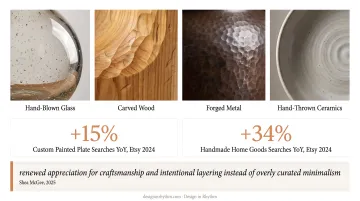
Hand-blown glass, carved wood, forged metal, hand-thrown ceramics—pieces that reveal how they were made carry a quality no algorithm can replicate. According to Etsy's 2024 trend data, searches for custom painted plates rose 15% year-over-year, with handmade home goods up 34%. Designer Shea McGee echoed the shift in late 2025, noting a "renewed appreciation for craftsmanship and intentional layering instead of overly curated minimalism."
The challenge is sourcing pieces with real craft provenance—not craft-adjacent mass production—from makers who don't show up in mainstream retail. That's work that requires relationships built over years, not a shopping cart. Design in Rhythm's vendor network, developed over more than a decade, connects clients to artisan workshops, independent furniture makers, and statement lighting sources that most buyers simply can't access on their own.
The Return of Natural Materials and Warmth
2026's material story rewards irregularity. Surfaces that show their making process—grain, imperfection, patina—are replacing the uniform polish that defined the previous decade.
Dark Wood Revival
Architectural Digest's December 2025 review described 2025 as marking a "distinct dimming of the ubiquitous bright Scandi aesthetic" in favor of "luxurious, dark timbers" across both residential and restaurant interiors. Walnut, warm oak, and reclaimed pieces with visible grain are the direction—not just darker in color, but richer in character.
Key applications:
- Cabinetry: Deep-toned wood replacing white or pale grey kitchen units
- Bedroom furniture: Sleigh-style beds in timber making a return
- Unfitted kitchens: Standalone oak or walnut pieces instead of matched fitted units
- Mixing finishes: Vary wood tones within a room—light, medium, and dark—rather than matching species throughout
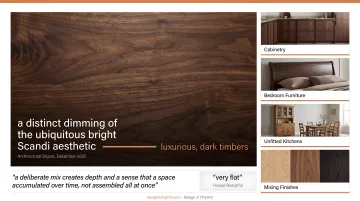
One designer quoted in House Beautiful noted that matching woods can feel "very flat," while a deliberate mix creates depth and a sense that a space accumulated over time, not assembled all at once.
Earthy and Emotive Color Palettes
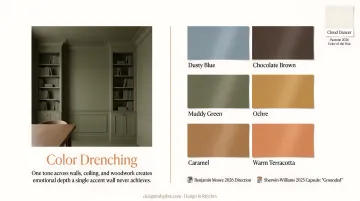
Grey's decade-long reign as the default neutral is giving way to warmer, moodier alternatives. The palette gaining traction pairs Pantone's 2026 Color of the Year, Cloud Dancer—a luminous, airy white—as a clean base with:
- Dusty blues and chocolate brown
- Muddy greens and ochre
- Caramel and warm terracotta
Benjamin Moore's 2026 direction and Sherwin-Williams' 2025 capsule (anchored by an earthen brown called Grounded) both reinforce the move toward warmer, more emotive ground tones. These tones work because they hold a room — they give spaces a grounded, settled quality that cool greys and whites simply can't achieve.
Color drenching—applying the same tone to walls, ceiling, and woodwork—is the technique giving these palettes real impact. A single muddy green drenched across a small library or dining room creates the kind of emotional depth that a single accent wall never achieves.
Natural Textures and Sustainable Materials
Beyond color, texture carries equal weight. Authentic stone with irregular surface variation, smoked and reeded glass, matte patinated metals, and materials with visible craft origins are chosen for how they feel underhand and underfoot — not just how they photograph.
The sourcing expectation has shifted too. The ASID's 2025 Trends Outlook identified sustainability, long-lasting materials, and handcrafted elements as top priorities for designers — responsible sourcing is now a baseline expectation, not a differentiator.
Romance, Texture, and Decorative Details
If the past decade belonged to restraint, 2026 belongs to abundance—at least in terms of sensory richness. The romantic turn in interiors is visible across soft furnishings, wall treatments, and decorative details.
Unbridled Romanticism
Romantic interiors in 2026 mean floral fabrics, climbing botanical motifs, rooms that feel transportive and slightly untamed. Architectural Digest's profile of LA designer Francesca Grace described her Silver Lake bungalow as maximalist, botanical, fringed, and moody—cottagecore with genuine conviction.
The broader hospitality industry tracked a similar shift: AD's BDNY 2024 report observed that "imaginative maximalism is on its way in," with demand for immersive, emotionally resonant spaces and dynamic floral scenes.
This translates directly to window treatments: layered drapes paired with relaxed Roman shades in matching or tonal fabric, bamboo blinds adding organic texture and warm light filtration.
Textile Wall Hangings and Heirloom Fabrics
Tapestries are having a moment. Architectural Digest reported in August 2025 that finely woven tapestries had seen a "recent revival as statement artwork," with designers describing them as a meaningful alternative for clients fatigued by conventional gallery walls.
Practical considerations for textile wall art:
- Hang tapestries on a rod rather than framed, for a relaxed, lived-in effect
- Skip the glass—it defeats the purpose of appreciating texture
- Grasscloth wallcoverings bring similar dimension and patina to full walls
- Antique rugs hung horizontally make striking, unexpected focal points
Heirloom textiles—vintage-inspired blankets with geometric or plaid patterns—work as throws, headboard fabric, or wall hangings. The key quality is longevity: pieces designed to be passed down, not rotated out with the next trend cycle.
Decorative Detailing: Fringing, Tassels, and Trims
Fringe is back, and not tentatively. AD's 2024 feature on the trend quoted Emma Roberts saying "there can never be enough stripes or fringe or tassels in a house." Designer Madelynn Hudson was clear that this isn't your grandmother's sofa fringe—bullion, beaded, brushed, and tasseled variations read as deliberately curated rather than dated.
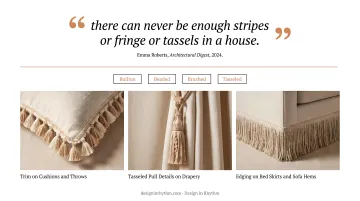
The easiest entry points: trim on cushions and throws, tasseled pull details on drapery, and edging along a bed skirt or sofa hem. Any one of these reads as intentional—none requires reworking the whole room.
Statement Surfaces and Artisan Finishes
Uniform finishes are giving way to surfaces with intention. In 2026, the most compelling rooms aren't the ones with the most furniture—they're the ones where every finish was chosen for a reason.
Lacquered Statement Pieces
Deeply colored lacquered furniture—coffee tables, cabinets, dining chairs—in jewel tones like burgundy and forest green commands attention without overwhelming a room. AD's 2025 forecast quoted designer Martha Mulholland saying "glossy lacquer is a big yes for 2025" for wall finishes, and the momentum has carried into 2026.
A single lacquered statement piece can shift a neutral room without a full redesign. The immersive application—lacquered ceilings, used sparingly—creates a high-impact architectural moment that photographs and experiences completely differently from standard paint.
Lacquer works across contexts:
- Coffee tables and cabinets in deep jewel tones anchor living spaces
- Dining chairs in forest green or burgundy add warmth without bulk
- Lacquered ceilings, used selectively, create an enveloping architectural moment
Hand-Painted and Artisan Tiles
The tile story in 2026 is about craft and narrative. Coverings 2025 identified handmade-looking tiles as a major focus—valued for tactile connection and visual storytelling over uniformity.
Floral engravings, painterly glazing, and traditional brushstroke patterns bring nostalgia and softness to kitchen backsplashes, bathroom walls, and fireplace surrounds.
Hand-painted, bespoke tile by ceramic artists is becoming a marker of thoughtful design over mass production. Those slight irregularities—a glaze that pools differently on each piece, a brushstroke that shifts from tile to tile—are the point.
Redefining Space: Purpose-Driven Rooms and Collectible Furniture
The Return of Defined Rooms
After two decades of open floor plan dominance, there's a genuine reconsideration underway. Hart Howerton partner Teddy McCarthy articulated it plainly in 2026 commentary: clients are rediscovering the romance and function of rooms designed for particular uses—drawing rooms, intimate dining rooms, defined libraries—as a response to the sprawling sameness of large open-living spaces.
In boutique hospitality, distinct spatial experiences shape the guest journey in ways undivided open spaces can't. A bar that feels unmistakably like a bar, a dining room with its own identity, a lounge that invites lingering — each of these gives guests something to remember.
Collectible and Occasional Furniture
The 1stDibs survey found 62% of designers planning to source antiques and 81% sourcing vintage 20th-century pieces for 2025 projects. The direction is clear: furniture with provenance, authorship, and character is replacing fast-furniture as the design investment that carries meaning over time.
This includes occasional pieces — non-essential furniture placed for joy rather than utility:
- A vintage bench reupholstered in a bold fabric, positioned in a hallway purely for visual impact
- A beautifully proportioned chair in a bedroom corner with no function beyond its form
- A sculptural side table that exists to hold a single object and anchor a corner
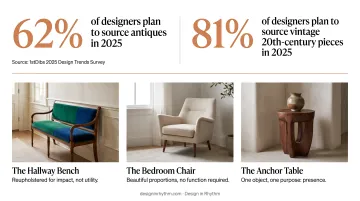
Spaces that include these pieces feel considered. They tell you someone made deliberate choices, not just practical ones.
How to Bring 2026 Trends Into Your Home or Hospitality Space
No single space should attempt all 12 trends at once. The art is choosing 2-3 that resonate with your actual lifestyle or brand story, then executing them with depth rather than checking boxes.
High-impact, lower-commitment starting points:
- Add a lacquered cabinet or coffee table in a jewel tone to a neutral room
- Introduce a textile wall hanging in place of framed artwork
- Update window treatments with layered Roman shades and drapes in matching fabric
- Source hand-painted tile for a backsplash or fireplace surround
- Bring in one piece of vintage or artisan-made furniture with genuine provenance
The sourcing challenge is real. Many of the materials and finishes defining 2026—lacquered custom furniture, hand-painted tiles, bespoke textiles, artisan-made pieces—aren't available through mainstream retail. That's where trade relationships built over years in the industry become genuinely useful.
Design in Rhythm's network of artisan workshops, custom furniture makers, and specialty vendors gives clients access to materials and finishes that simply don't show up in mainstream retail. Their process sources every product before creating photorealistic 3D renderings. So when you're deciding whether to commit to a lacquered ceiling or a hand-painted tile backsplash, you see the exact material in context before anything is ordered. As one client noted: "I had a rendering of my would-be apartment before getting started, so being very picky, it was a huge relief."
That removes the guesswork from statement investments and prevents the costly mistake of approving a concept that looks different in reality.
Frequently Asked Questions
What interior design styles are trending right now?
2026 design is defined by lived-in authenticity, romantic maximalism, and artisanal warmth—a move away from minimalism toward spaces that feel personal and human. Eclecticism, vintage sourcing, and handcrafted materials are the shared language across most trending directions.
What color is replacing grey?
Earthy, emotive tones—dusty blues, chocolate brown, muddy greens, caramel, and ochre—are gaining significant ground as primary color stories. Pantone's 2026 Color of the Year, Cloud Dancer, offers a luminous white as a clean base. Grey hasn't disappeared, but it's no longer the automatic default neutral it was for the past decade.
What is the 3-5-7 rule in interior design?
The 3-5-7 rule refers to grouping decorative objects in odd numbers—three, five, or seven—for visual balance. Within each grouping, vary the heights and sizes to create rhythm and interest. Even numbers tend to feel static and symmetrical; odd groupings create more natural, collected-looking arrangements.
Are open floor plans going out of style in 2026?
Yes—designers are pointing toward a return to defined, purpose-built rooms: drawing rooms, intimate dining spaces, dedicated libraries. These offer spatial identity and old-world function that open plans simply can't replicate.
What is the anti-algorithm trend in interior design?
Anti-algorithm design is a pushback against spaces that look identical because they drew from the same trending images online. The alternative is personal, eclectic choices that reflect the actual inhabitants—objects with stories and combinations that no algorithm would approve.
How do I incorporate 2026 trends without a full renovation?
Start with a single statement piece—a lacquered cabinet, a textile wall hanging, or a hand-painted tile for a backsplash or fireplace surround. Updating window treatments with layered drapes and Roman shades in tonal fabric is another high-impact, lower-cost change.