The real problem most homeowners face isn't budget. It's the gap between "looks expensive" and feels luxurious. They overspend on statement pieces that fight each other for attention, or under-invest in the foundational details — lighting layers, proportion, materiality — that actually create the atmosphere they're after.
This guide covers the philosophy behind true luxury design, the essential elements that form its foundation, how proportion and material choices work together, and the sophisticated finishing details that separate a beautifully decorated room from a genuinely extraordinary one.
Key Takeaways
- Intentionality and cohesion define luxury — how a room feels together matters far more than the cost of individual pieces
- Layered lighting, a properly scaled rug, and a defined focal point are the three non-negotiable foundations
- Premium natural materials and restrained metallic accents create richness without visual noise
- The 2/3 rule is your most reliable shortcut to visual balance throughout the room
- The final edit — cutting what doesn't belong — is what separates a decorated room from a sophisticated one
What Truly Defines a Luxury Living Room
Luxury is first an atmosphere. The most sophisticated spaces don't announce themselves — they make their presence known through material quality, compositional precision, and an intangible sense that nothing arrived by accident.
AD100 designers consistently connect luxury with emotional effect, restraint, and personalized curation rather than visible expenditure. Kelly Wearstler describes varied seating, luxurious textures, distinctive silhouettes, and layered materiality as the tools for creating environments that leave a lasting visual memory. The common thread isn't price — it's intentionality.
The Principle of Intentionality
In a truly luxurious living room, nothing is accidental. Each piece of furniture, lighting fixture, textile, and decorative object has earned its place. Contrast this with spaces that accumulate expensive items without a unified vision — they read as costly, not curated.
A room with three exceptional, well-chosen pieces will always outperform one crowded with expensive-looking items competing for attention. The luxury is in the selection discipline, not the volume.
The Hospitality Design Lens
High-end hotels engineer atmosphere from the moment a guest crosses the threshold. Sightlines, materiality, lighting, and even scent are all deliberate tools — nothing is left to chance. Residential luxury can apply the same thinking.
Design in Rhythm has spent over a decade working across boutique hotels and private residences, and the cross-sector philosophy is direct: the sensibility that shapes a hotel lobby (how a guest moves through the space, what they see first, what they feel underfoot) translates precisely into how a living room is composed and sequenced. In practice, this means considering:
- Entry sightlines — what draws the eye the moment someone steps inside
- Material sequencing — how textures and finishes shift as you move through the room
- Light layering — ambient, task, and accent sources working in deliberate combination
- Acoustic comfort — textiles and soft surfaces that shape how the room sounds, not just how it looks
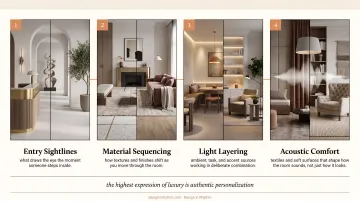
The highest expression of luxury is authentic personalization. A space that reflects the owner's genuine story and way of living — rather than a trend lifted from a magazine — is what separates truly remarkable rooms from ones that feel like they could belong to anyone.
The Essential Design Elements of a Luxury Living Room
Layered Lighting
A single overhead light source is the fastest way to undermine a luxury interior. Flat, uniform illumination flattens texture, kills atmosphere, and signals a lack of design sophistication.
ASID defines the three-layer lighting hierarchy this way:
- Ambient — overall fill lighting that establishes the room's base illumination
- Task — functional lighting for reading or specific activities
- Accent — lighting that highlights architectural features, artwork, and objects
A sculptural chandelier or dramatic pendant above the primary seating area functions as both the room's ambient anchor and a work of art in its own right. But it's the supporting layers — wall sconces, floor lamps, picture lights — that create depth and warmth.
Dimmers are non-negotiable. Every circuit should be independently dimmable so the room can shift from daytime clarity to evening warmth. This single upgrade transforms how a space feels across different times of day.
The Anchor Pieces: Sofa and Rug
The sofa is the room's primary instrument — everything else is composed around it. Three factors determine whether it works:
- Scale — an undersized sofa destroys proportion in a large room; it reads as tentative
- Silhouette — curved profiles create warmth and conversation; structured rectilinear forms signal formality
- Fabric quality — a performance-grade velvet holds its hand and sheen over years; a surface-level velvet collapses within months
The sofa is the single piece most worth investing in.
The rug is the room's compositional foundation — the element that defines the seating area and creates visual cohesion beneath it. Sizing is where most people go wrong. An undersized rug is one of the fastest ways to break a luxury interior.
According to STARK's rug materials guide, wool offers durability, wear resistance, and natural character suited to high-traffic areas, while silk delivers a softer hand and subtle sheen but performs better in lower-traffic settings. Nylon and polypropylene can outperform natural fibers on specific stain and moisture resistance criteria — so material choice should follow how the room is actually used, not just how it looks.
For placement, an all-legs-on arrangement — where the rug is large enough to anchor the complete seating group as a single composition — is the right standard. In a generous living room, that typically means a 9×13 or larger.
A Defined Focal Point
Every luxury living room needs one primary visual anchor — the element the eye moves to first and the organizing principle around which the rest of the room is composed.
The most effective options:
- A fireplace surround (marble or stone facing elevates this dramatically)
- Floor-to-ceiling windows framing a commanding view
- A single large-scale artwork hung with generous negative space
- An extraordinary piece of furniture positioned deliberately
Architectural Digest identifies the fireplace as an instant focal point that frequently establishes symmetry and creates a natural surface for art and objects — making it the best-supported traditional anchor in luxury residential design.
When the architecture doesn't naturally provide a focal point, one can be created through scale, placement, and negative space. What can't work is competing focal points — a gallery wall, a fireplace, and a large sectional all demanding equal attention simultaneously produces visual noise, not composition.
Luxury Color Palettes and Premium Material Choices
Three Color Registers
Luxury isn't a specific color — it's a tonal relationship. There are three registers to choose from:
- Sophisticated neutrals — warm beiges, taupes, stone creams, and greige tones that create the illusion of natural light and seamless space
- Deep anchors — navy, charcoal, forest green, cognac that add gravitas and sophistication
- Moody dramatists — ink black, deep plum, dark slate for spaces designed to feel intimate and enveloping
ELLE Decor's 2024 color forecast noted warm light brown replacing gray as the neutral of choice, while AD PRO's trend reporting documented designers favoring taupes, beiges, cognac, and earthbound shades across luxury residential work. Choose one register and stay within it — tonal cohesion is what reads as luxury, regardless of the specific hues selected.
Metallic Accents: The Room's Jewelry
Metallics — brass, aged bronze, blackened steel, unlacquered hardware — function as the room's jewelry. Designer Melissa Lee describes a preference for mixed warm metals like bronze, aged brass, and hammered copper for their "substantial craft and patina."
The key is restraint and consistency:
- One or two metal tones used across lighting, hardware, and decorative objects unifies the space
- Mixing four or five metallic finishes creates visual noise
- Warm metals (brass, bronze) read as timeless; cool metals (chrome, polished nickel) read as contemporary
The Premium Material Hierarchy
| Material Category | Best Applications | Luxury Contribution |
|---|---|---|
| Natural stone (marble, limestone, travertine) | Fireplace surrounds, surfaces, flooring | Visual drama, tactile weight |
| Solid hardwoods (herringbone or chevron parquet) | Flooring | Artisan craftsmanship signal |
| Plush fabrics (velvet, linen, leather, cashmere) | Upholstery, cushions, throws | Tactile richness, layered warmth |
| Brass / aged bronze | Lighting, hardware, decorative objects | Finishing warmth and cohesion |
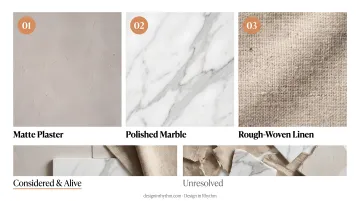
The tactile quality of these materials creates an experience that synthetic alternatives simply cannot match. Material cohesion, though, matters as much as material quality. Matte plaster walls set against polished marble and rough-woven linen creates a richness that feels considered and alive. Haphazard mixing reads as unresolved.
Proportion, Layout, and the Design Rules That Actually Matter
The 2/3 Rule
The 2/3 rule is the designer's most reliable shortcut to visual balance. Applied as a proportion heuristic (not a mathematical formula):
- The area rug should cover approximately two-thirds of the seating area's footprint
- The coffee table should span roughly two-thirds the length of the primary sofa
- Artwork should fill approximately two-thirds of the wall width above a console or sofa
Violating it — particularly with an undersized rug or an overly small piece of art — immediately signals a lack of design confidence. The ratios feel intuitively harmonious because they approximate the golden ratio, but treat the rule as a starting point, not a theorem.
Once proportions are established, where you place furniture determines whether the room actually functions as a luxury space.
Furniture Arrangement Principles
Float furniture away from walls.
The "waiting room perimeter" arrangement — every piece pushed to the edges — is one of the most common luxury-breaking mistakes in residential design. Designer Louis Lin explains that floating furniture opens circulation paths, helps define zones, and can make a room appear larger.
Additional principles:
- Establish clear traffic flow paths that feel intuitive rather than obstructed
- Use symmetry to signal formality — and break it deliberately when the composition needs tension
- Avoid asymmetry that reads as accidental; every offset should feel intentional
- Create intimate conversation zones rather than one undifferentiated central grouping
The Vertical Dimension
Ceiling height — real or perceived — is one of the most powerful contributors to a room's sense of grandeur. Three tools amplify perceived height:
- Floor-to-ceiling drapery hung close to the ceiling — even on windows that don't extend that high — can add several apparent feet of perceived height
- Tall art and vertical architectural elements like fluted paneling or built-in bookcases draw the eye upward
- Coffered or painted ceilings create the "jewel box" effect that makes the ceiling itself a destination rather than an afterthought
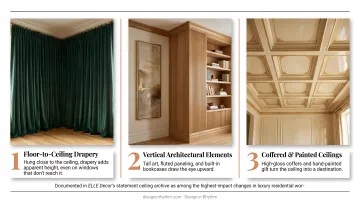
ELLE Decor's statement ceiling archive documents residential examples using high-gloss coffers, hand-painted gilt, and saturated paint overhead — techniques that consistently rank among the highest-impact changes in luxury residential work.
Sophisticated Finishing Details That Elevate Good Design to Great
Curated Art and Objects
A luxury living room should include fewer, larger, more personally resonant pieces — not many small decorative items. The difference between a gallery wall that tells a story and a collection of framed prints that fill wall space is significant: one has curation logic, the other has accumulation logic.
Invest in one or two significant pieces — original work, antique finds, or artisan objects with genuine meaning. Guests remember these. A single sculptural object, given room to breathe, signals deliberate taste. A shelf crowded with collected things signals the opposite.
Architectural Details as Luxury Multipliers
Architectural details are available to almost any space — newer builds included. Common options worth considering:
- Crown molding and ceiling medallions
- Wall paneling (fluted, shiplap, or V-groove)
- Built-in cabinetry and fireplace surrounds
- Applied molding, decorative plaster, and custom millwork
In newer builds without these features, the last two categories do the same work that older homes carry naturally in their bones.
These details matter for two reasons: they photograph exceptionally well, and they become the bones that all other design choices rest against. A room with strong architectural detailing can carry simpler furniture and still read as sophisticated — because the structure itself does the heavy lifting. Strip that away, and every other element has to compensate.
The Final Edit
The hallmark of sophisticated design is restraint. After assembling all the elements, the act of removing the last 10–20% — the extra throw pillow, the third table accessory, the redundant side table — is often what separates a room that feels sophisticated from one that simply feels decorated.
This is where working with an end-to-end design firm pays off most clearly. Design in Rhythm sources and confirms every product before rendering — so what clients see is exactly what arrives on-site. Because nothing enters the plan speculatively, there's nothing to edit out later. Every element belongs. The absence of excess is the point.
Frequently Asked Questions
What makes a living room look luxury?
Luxury in a living room comes from material quality, cohesive composition, layered lighting, and the absence of clutter. A room with three well-chosen pieces and proper lighting reads as more luxurious than one filled with costly furniture arranged without compositional logic.
What is the 2/3 rule for living rooms?
The rug should cover roughly two-thirds of your seating area's footprint, and the coffee table should be approximately two-thirds the length of the sofa. Applied consistently, these proportions create visual balance that feels natural rather than forced.
What are the best color palettes for a luxury living room?
The most effective luxury palettes fall into three groups: sophisticated neutrals (warm beige, taupe, stone cream), deep anchors (navy, forest green, charcoal), and moody darks (ink black, deep plum). Whichever direction you choose, tonal cohesion within that palette matters more than the specific hues.
What materials are considered luxury for interior design?
Natural stone (marble, limestone, travertine), solid hardwood flooring, and premium textiles (velvet, linen, leather, cashmere) form the foundational material hierarchy. Brass or aged bronze metallic accents function as the finishing layer that ties the room together.
How do I create a focal point in my luxury living room?
A focal point can be a fireplace, a commanding piece of artwork, floor-to-ceiling windows, or a significant furniture piece surrounded by negative space. The key is ensuring only one element claims visual dominance — when two elements compete for attention, neither wins.
Do I need a professional interior designer for a luxury living room?
Individual upgrades can improve any space, but a professional designer provides the cohesive vision, trade-grade material access, and project management that individual purchases can't replicate. The result is a room where everything belongs together — not just a collection of good choices.