For boutique hotels, restaurants, and companies competing in tight office markets, physical space has become something you can measure against revenue, retention, and brand perception. Yet interior design still gets treated as a line item for paint and throw pillows.
That framing misses the point entirely. Design shows up in occupancy rates, guest spend, leasing velocity, and how long employees stick around. This article breaks down why interior design matters in practice, not just how a finished space photographs, but how it performs for the business behind it.
Key Takeaways
- Interior design drives revenue through guest behavior and spend, beyond aesthetics
- Workplace design measurably affects retention, engagement, and recruiting costs
- Distinct, well-executed spaces drive differentiation in crowded markets
- Skipping design planning leads to inconsistent experiences and reactive spending
- The biggest returns come from treating design as an ongoing strategy rather than a single project
What Is Interior Design in a Business Context
Interior design, in a business setting, is the strategic planning of layout, materials, lighting, and furnishings to support a specific outcome. It's problem-solving with spatial tools, not decorating.
That distinction matters because it changes how a business should approach design decisions. Instead of asking "what looks good here," the better question is "what does this space need to accomplish?"
Businesses typically apply this thinking across a few core settings:
- Hospitality — boutique hotels, restaurants, and bars where guest experience drives repeat business
- Private residences — homes designed around how the people living there actually use each room
- Commercial lobbies and common areas — shared spaces that shape how visitors and residents perceive a property
- Mixed-use developments — properties where shared space quality affects leasing performance
In each case, design serves an outcome: a stronger guest experience, a home that truly fits how someone lives, or a clearer brand story told through physical space. Treated this way, interior design becomes an operational lever rather than a cosmetic afterthought.
Key Advantages of Interior Design for Business Success
The advantages below focus on operational impact, not abstract aesthetic value. Each one connects to metrics businesses already track: revenue, cost, retention, and growth.
Elevates Guest and Customer Experience to Drive Revenue
Guests and customers form judgments the moment they walk through a door. Layout, lighting, and material choices guide those judgments and shape behavior in turn.
In boutique hospitality and retail, this shows up directly in how much someone spends and whether they come back. A well-lit dining room with intentional seating flow keeps guests comfortable longer. A hotel lobby that signals quality upfront sets pricing expectations before a guest even reaches the front desk.
Why this matters financially:
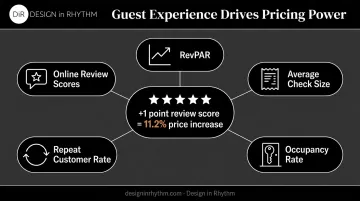
Cornell's hospitality research found that a one-point increase on a five-point online review scale allowed hotels to raise prices by 11.2% while maintaining the same occupancy. Guest perception, shaped heavily by physical environment, translates directly into pricing power.
KPIs this advantage affects:
- RevPAR (revenue per available room)
- Average check size
- Occupancy rate
- Repeat customer rate
- Online review scores
This advantage matters most for boutique properties competing against larger chains with bigger marketing budgets, or for any business mid-launch or repositioning. When you can't out-market a competitor, your space has to do the convincing instead.
Boosts Employee Productivity, Retention, and Workplace Culture
A workplace either supports how people actually work or fights against it. Ergonomics, lighting, acoustics, and layout all determine which one is true.
Strategic zoning, separating focus areas from collaboration hubs, matters more now that hybrid teams split time between home and office. A space with no quiet corners pushes people toward distraction. One with no gathering spots kills spontaneous collaboration.
The retention connection is measurable:
Gensler's 2025 Global Workplace Survey found that employees in highly rated workplaces were 2.5 times more likely to report the space supports their productivity, and nearly three times more likely to say they plan to stay with their employer.
That second number matters more than it looks. Replacing an employee isn't cheap.
KPIs this advantage affects:
- Employee retention rate
- Absenteeism
- Engagement scores
- Time-to-fill vacancies
This advantage carries the most weight in talent-competitive industries, during office relocations, or whenever a company is scaling headcount fast and needs the space to keep pace with hiring.
Strengthens Brand Identity and Competitive Differentiation
Physical space is a tangible expression of what a brand claims to stand for. Anyone can write "boutique" or "authentic" in marketing copy. Fewer businesses can back that up with a room that feels the part.
Delivering on that promise requires more than a good concept. It requires an execution process where the finished space actually matches what was approved.
At Design in Rhythm, that means sourcing every product before renderings are created, so what a client signs off on is exactly what gets installed. No substitutions, no last-minute swaps that change the brand story midstream.
Differentiated space has a market value:
JLL found that mixed-use developments with strong environmental design commanded rents 32% above other Class A space and reached full lease-up roughly twice as fast as traditional developments. Distinctive, well-executed environments don't just look better. They perform better financially.
KPIs this advantage affects:
- Brand recall
- Social and user-generated content mentions
- Customer acquisition cost
- Press and media coverage
This advantage is most valuable in markets crowded with similar venues, or when a business is entering a new market and needs its space to do some of the marketing work on day one.
What Happens When Interior Design Is Missing or Ignored
Skipping strategic design planning doesn't save money. It usually just delays the cost.
- Inconsistent experience across locations: Without a unified design approach, each new property or venue feels like a different brand entirely
- Higher long-term costs: Reactive fixes and piecemeal renovations almost always cost more than planning correctly the first time
- Lower morale, higher turnover: Poor lighting, cramped layouts, and noisy open floors wear people down over time
- Scaling problems: Growing a brand across multiple locations gets harder without a consistent design framework to build from
Each of these problems compounds. A hotel group that ignores design consistency across three properties ends up with a brand recognition problem, one that costs far more to fix than the original design gaps ever would.
How to Get the Most Value from Interior Design Investment
Design pays off when it's treated as an ongoing business practice that continues well past opening day.
That means reviewing outcomes against actual KPIs after launch, such as occupancy, guest spend, and retention, rather than assuming a beautiful rendering automatically translates into business results.
Practical steps to protect that investment:
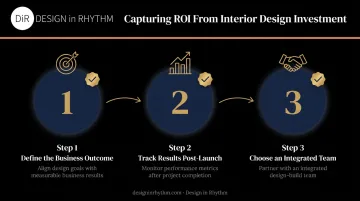
- Define the business outcome first: Decide what the space needs to achieve (higher spend, longer stays, better retention) before design decisions get made
- Track results post-launch: Compare guest reviews, occupancy, or retention data before and after the redesign
- Choose an integrated team: Separate design, procurement, and installation vendors create the most common failure point in these projects: a finished space that doesn't match what was approved
That third point is where most projects actually go sideways. Late deliveries, mismatched finishes, and contractors pointing fingers at each other all stem from fragmented coordination.
Design in Rhythm addresses this by keeping design, procurement, and logistics under one team from the first conversation through final installation. The same people who developed the concept oversee the sourcing and the install, which removes the handoff gaps where design intent typically gets lost.
Conclusion
A beautifully photographed space grabs attention, but interior design's real value lies in the clarity and consistency it builds across guest experience, employee performance, and brand differentiation.
These advantages compound. A well-designed hotel lobby keeps earning its cost back through repeat bookings for years. A workplace that supports focus keeps paying dividends through lower turnover long after the furniture bill is settled.
Treat interior design as a continuous strategic investment that keeps paying off well past the ribbon-cutting. Design in Rhythm builds that value into every hospitality and residential project, from concept through installation.
Frequently Asked Questions
What is interior design and why is it important?
Interior design is the strategic planning of space, layout, and materials to serve both function and business goals. It's important because it directly shapes how customers, guests, and employees behave and feel in a space.
What are three qualities of a good interior designer?
A good interior designer needs strong discovery and listening skills to understand real client goals. Equally important are technical knowledge of materials and building codes, plus project management ability to carry a vision through to final installation without losing the original intent.
What are the 7 key elements of interior design?
Space, line, form, light, color, texture, and pattern. These elements combine to create environments that are both functional and emotionally resonant for the people using them.
How does interior design impact employee productivity?
Ergonomics, lighting, and layout choices reduce distraction and support different work modes, from focused solo work to team collaboration. Poorly designed spaces work against productivity by forcing employees to fight their environment.
How much should a business budget for interior design?
Budgets vary widely by project type, scope, and location. Consulting a design firm directly for a tailored estimate based on your specific goals and space size will give you a far more accurate number than any general range.
Can interior design really increase revenue for hospitality businesses?
Yes. Design shapes guest spend, repeat visits, and online reviews, which directly affect pricing power and occupancy. Guest perception formed through physical environment translates into measurable revenue outcomes over time.