Key Takeaways
- True luxury comes from cohesion — concept, lighting, materials, and acoustics working toward one emotional effect
- The interior communicates the culinary philosophy before guests ever see a menu
- Table spacing, acoustic design, and private dining are as decisive as surface finishes
- Sourcing every product before renderings means what you see is exactly what gets built
- Custom furniture and artisan materials depend on trade relationships that take years to build
Every Great Luxury Restaurant Starts with a Story
Before a single material is chosen or layout sketched, the most important design decision is already in play. That decision is the concept narrative: who this restaurant is, what it celebrates, and what emotion a guest should carry home.
The clearest proof of this principle is Logy, the Taipei fine dining restaurant designed by Keiji Ashizawa in 2025. Rather than applying a generic luxury aesthetic, Ashizawa built the entire interior around chef Ryogo Tahara's Taiwanese and Japanese ingredients — brick, plaster, walnut paneling, round wood tables referencing Taiwanese dining traditions, and steel-pipe lights shaped to resemble bamboo stalks. The designer described the intent as wanting to "harmonise with the indigenous ingredients." The result is an interior that could not exist anywhere else or serve any other cuisine.
That specificity is the point.
Connecting Concept to Cuisine and Brand Identity
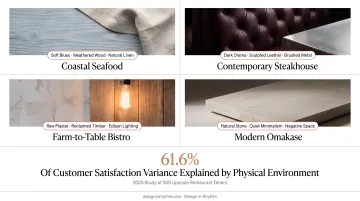
The interior should communicate the culinary philosophy before guests even see a menu. The material palette and spatial proportions function as a visual extension of the food itself. Each concept type signals something different through design:
- Coastal seafood — soft blues, weathered wood, natural linen texture
- Contemporary steakhouse — dark drama, sculpted leather, brushed metal
- Farm-to-table bistro — raw plaster, reclaimed timber, warm Edison lighting
- Modern omakase — quiet minimalism, natural stone, deliberate negative space
The strongest restaurant brands have interiors so specific to their identity that transplanting them anywhere else would destroy their meaning. Design in Rhythm's St Felix Las Vegas illustrates this exactly. A focal wall featuring bold pink "Sin City" lettering, plush red leather bench seating, crimson patterned wallpaper, and bar shelves bathed in purple light — these aren't interchangeable design choices. They're a declaration of place. Move that interior to Chicago or Miami and it loses its entire meaning.
Contrast this with "generic luxury" — spaces that are undeniably expensive but could belong to any restaurant in any city. Guests recognize this instinctively. The result is a space that impresses once but builds no loyalty.
Research from a 2025 study of 305 upscale restaurant diners found that physical environment dimensions explained 61.6% of the variance in customer satisfaction — and satisfaction drives return visits. Generic luxury cannot capture that.
The concept also needs to serve the target guest's lifestyle, not only the owner's vision. Modern fine dining guests prioritize atmosphere and personality as much as formality. A narrative written only for the owner rarely lands with the people actually sitting in the room — and those are the only opinions that fill seats.
Entrances, Layout, and Flow: Setting the Stage from the First Step
Guests form their most lasting impression before they're seated — and the entrance does that work. Every element in those first seconds is functional, not ornamental:
- Premium materials at doors and thresholds establish the quality register immediately
- Architectural lighting draws the eye inward and sets emotional tone
- Subtle, unforced branding signals confidence without overstating
- A sensory shift from street noise to dining room quiet signals arrival
What the Floor Plan Actually Communicates
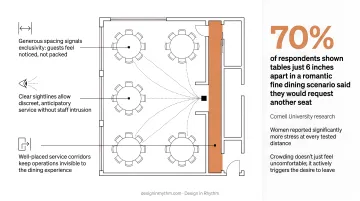
Spatial flow and floor plan planning are as much about operational excellence as aesthetics. Three things table spacing communicates simultaneously:
- Generous spacing signals exclusivity — guests feel noticed, not packed
- Clear sightlines allow discreet, anticipatory service without staff intrusion
- Well-placed service corridors keep operations invisible to the dining experience
Cornell researchers found that 70% of respondents shown tables just 6 inches apart in a romantic fine dining scenario said they would request another seat. Women reported significantly more stress at every tested distance. Crowding doesn't just feel uncomfortable — it actively triggers the desire to leave.
Restrooms as a Brand Statement
In a luxury restaurant, the restroom is a proof point. Guests step away from the dining room and immediately take inventory. What they find — or don't find — recalibrates their entire read of the experience.
Details that hold the standard:
- Fixtures and finishes that match the material palette of the main space
- Lighting that flatters rather than flattens (warm, not clinical)
- Fresh flowers, quality hand products, or a curated scent that extends the atmosphere
- Surfaces maintained to the same standard as the dining floor
A restroom that dips below the quality of the dining room answers a question guests weren't consciously asking — and the answer works against you.
Lighting, Materials, and Finishes: The Sensory Language of Luxury
Layered Lighting: Ambient, Accent, and Task
The IES analysis of more than 50 Manhattan restaurants found that 75% had table illuminance below 1.3 foot-candles — and identified layering and control as the framework for getting it right. Ambient light sets mood, accent lighting creates focal depth, and task lighting serves function. No single layer can do all three, which is why the combination matters more than any individual fixture.
Dimmability is non-negotiable for a space that transitions from lunch to dinner service. The room that works at noon is not the room that works at nine. Warm LED tones affect how guests perceive both the space and the food on the plate.
Beyond mood, lighting functions as architectural punctuation:
- Custom pendants define individual dining zones without physical barriers
- Backlit wine walls create focal depth across an entire room
- Floor-level illumination adds drama without visual clutter
- Programmable systems shift atmosphere through service without staff adjusting a single switch
The Material Palette: What Luxury Feels Like to the Touch
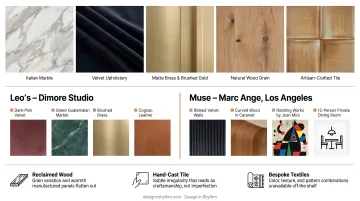
The materials most associated with high-end restaurant interiors — Italian marble, velvet upholstery, matte brass and brushed gold hardware, natural wood grain, artisan-crafted tile — are not luxurious in isolation. What creates genuine luxury is how they combine and contrast.
Two recent projects illustrate the principle well. Dimore Studio's Leo's supper club layered dark-pink velvet, green Guatemalan marble, brushed brass, and cognac leather — four materials that sharpen each other through contrast. Marc Ange's Muse in Los Angeles takes a quieter approach: ribbed velvet walls, curved wood details in caramel, rotating works by Joan Miró, and a 12-person private dining room that functions as a space within a space.
The through-line in both? Every surface choice was deliberate — and each material reinforces the others rather than competing for attention.
Tactile consistency matters as much as visual composition. Every surface a guest touches — door handle, table edge, chair upholstery, bar counter — should feel considered. A single metallic accent in a neutral room delivers glamour; the same accent used twelve times becomes noise.
High-caliber artisan materials reinforce that consistency in ways mass-produced finishes cannot:
- Reclaimed wood brings grain variation and warmth that manufactured panels flatten out
- Hand-cast tile introduces subtle irregularity that reads as craftsmanship, not imperfection
- Bespoke textiles hold color, texture, and pattern combinations unavailable off-the-shelf
Accessing this caliber of material requires established trade relationships. Design in Rhythm's procurement network — built over more than a decade — connects clients directly with artisans and trade-only vendors whose work doesn't reach mainstream retail channels.
Furniture, Art, and Installations That Signal Exclusivity
Bespoke Furniture: Function, Comfort, and Identity
Custom furniture carries personality that catalog sourcing cannot match. A bespoke piece reinforces the restaurant's narrative and cannot be replicated at a competitor's table.
The essential furniture types in a luxury dining space include:
- Curved leather booths that create semi-private conversation zones
- Sculptural bar stools that hold visual weight at the counter
- Velvet lounge chairs that invite longer stays
- Upholstered banquettes that define room perimeter without walls
Each must balance visual impact with ergonomic comfort. A chair that looks extraordinary but becomes uncomfortable after 20 minutes actively damages the experience and guarantees guests won't return for a long meal.
Proximity communicates energy; distance communicates exclusivity. Booth height, table spacing, and seating configuration shape the psychological experience before a word is spoken or a dish is served.
Design in Rhythm fabricates custom furniture through a vetted network of artisans and makers, built to commercial-grade durability standards with residential-level comfort. In high-traffic restaurant environments, that distinction matters more than it might appear on a spec sheet.
Art, Installations, and Statement Details
Furniture defines how guests inhabit a space. Art defines how they remember it — and in the best luxury restaurants, those two forces are inseparable.
Art in a luxury restaurant has moved beyond wall decoration. Atlanta's Atlas restaurant organized its entire identity around approximately two dozen 20th-century works — Francis Bacon, Picasso, van Gogh — making art the premise, not the punctuation. Oka and Fogo in Paris integrated Florence Bamberger's murals architecturally, giving the two adjoining dining rooms separate identities through art rather than construction.
The difference between curated original artwork and generic prints is apparent to anyone who walks in, even when they can't explain why. The former signals genuine investment. The latter signals the minimum.
Smaller craftsmanship details compound this signal:
- Hand-stitched upholstery along booth seams
- Custom door hardware that feels substantial in the hand
- Bespoke ceiling treatments that make guests look up
- Branded ceramic tableware that extends the identity to every surface guests touch
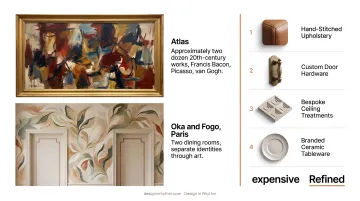
These are the details guests often can't consciously identify but collectively register as the difference between "expensive" and "refined."
Acoustic Design and Private Dining Spaces: The Intimacy Equation
A loud dining room kills the experience before the food arrives. Hard surfaces create harsh echoes, and when guests are raising their voices just to hold a conversation, the sense of intimacy that defines luxury dining disappears entirely.
Acoustic materials are woven into design invisibly:
- Upholstered seating absorbs mid-frequency sound
- Area rugs soften footfall across stone or hardwood floors
- Fabric panels, disguised as decorative wall elements, control reverberation
- Ceiling heights are planned with sound diffusion in mind from the earliest layout stage
Curated music is part of this equation. Every element — genre, tempo, volume — should be a conscious choice aligned with the brand's pace and identity. Music sets the mood and fills silence, but in a luxury context it should never be loud enough to compete with conversation.
Private Dining as a Design Multiplier
Private dining rooms create a sense of exclusivity the main floor cannot replicate. They generate premium revenue opportunities and allow the design team to introduce a distinct character — a restaurant within the restaurant. The National Restaurant Association reported in 2025 that 52% of consumers expressed interest in private dinners with a chef, signaling genuine demand for these elevated, contained experiences.
Successful private dining design includes:
- Tailored lighting that differs from the main room — more intimate, more theatrical
- Acoustic privacy that makes conversation feel truly private
- Bespoke service moments that can't happen at a general floor table
- A cohesive but distinct visual identity that makes guests feel they've been taken somewhere special
From Concept to Completion: Turning Luxury Inspiration Into a Real Space
Most restaurant interiors fail to match their original vision — not because the ideas were wrong, but because design decisions weren't validated before anything was ordered, built, or installed. That gap is where budgets blow and timelines collapse.
Why Renderings Must Show Reality, Not Aspiration
Most design firms produce renderings early, using placeholder furniture and approximate finishes. When actual sourcing begins, certain products are unavailable, discontinued, or incompatible. The finished space differs from what the client approved, and the result is costly revisions and eroded trust.
Design in Rhythm reverses this sequence: every product is sourced before renderings are created. The 3D visualization a client approves is not a concept — it's an exact representation of the materials, furniture, and finishes that will physically be installed. What you see is what arrives on site.
That sequence alone prevents the revisions, re-orders, and last-minute substitutions that quietly consume 10–20% of a project's budget.
The Complexity of Procurement and Logistics
Coordinating custom furniture makers, artisan vendors, specialty lighting suppliers, and installation sequencing requires experience and relationships that most restaurant owners simply don't have access to independently. The challenges that derail self-managed projects include:
- Multi-vendor coordination across simultaneous orders and timelines
- Delivery sequencing that must align with construction phases
- Receiving, inspecting, and warehousing goods until the space is ready
- Acting as a single accountable party when trades point fingers at each other
Design in Rhythm's procurement manager oversees this entire supply chain — purchasing, contracts, order tracking, warehousing, and staged delivery, all managed as one unified operation. Restaurant owners stay focused on their opening. Everything else is handled.
The Ideal End-to-End Process
The process that produces a truly luxurious result follows a clear sequence:
- Dream — Deep discovery conversation to surface the authentic concept narrative, documented in a written engagement letter before any design work begins
- Visualize — Photorealistic 3D renderings created from sourced (not placeholder) products, requiring client approval before procurement begins
- Source — Full procurement management through exclusive trade relationships, with every item tracked from order to delivery
- Build — Managed installation with a single point of contact from the first walkthrough to the final styling detail
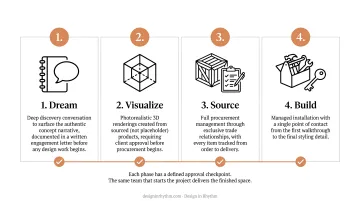
Each phase has a defined approval checkpoint. The same team that starts the project delivers the finished space. When opening day arrives, there are no surprises — only a space that looks exactly like what the client signed off on.
Frequently Asked Questions
What makes a restaurant interior feel truly luxurious?
True luxury comes from cohesion across every element — concept, lighting, furniture, acoustics, and spatial flow working together to serve a single emotional experience. Expensive materials alone don't create it. Intentional decisions that tell one consistent story do.
How important is lighting in a luxury restaurant design?
Lighting is the single most impactful element in fine dining design, shaping how guests perceive both the space and the food. A layered, dimmable system — ambient, accent, and task — is the baseline, and the ability to shift it through service transitions is what separates a polished result from a forgettable one.
What materials are most commonly used in high-end restaurant interiors?
Italian marble, velvet upholstery, matte brass and brushed gold hardware, natural wood, and artisan-crafted tile appear most frequently in luxury restaurant design. The combination and contrast between materials matters as much as the individual choices — pairing cool stone with warm wood creates harmony that either material alone cannot produce.
How do you create intimacy in a large luxury dining space?
Booth configurations create semi-private zones, pendant lighting defines individual tables without physical barriers, and acoustic treatments keep conversation from bleeding across the room. Stack two or three of these together and a 200-seat dining room can feel as personal as a 40-seat one.
Should a luxury restaurant's interior reflect its cuisine or its location?
The strongest interiors reflect both. St Felix in Las Vegas makes the city itself part of the brand identity rather than fighting it — that's the model. Start with a narrative that authentically connects cuisine and location, and neither one has to be sacrificed for the other.
How long does a full luxury restaurant interior design project typically take?
Most projects involving custom furniture and artisan materials require several months of planning before installation begins. Working with one integrated team — rather than coordinating separately across designers, vendors, and contractors — significantly reduces the delays that fragmented management almost always introduces.