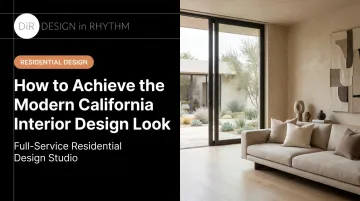
It's one of the most searched interior styles among American homeowners, and not only in California. The problem is that most people can pin the mood boards but can't translate them into a room that feels finished rather than borrowed from a rental catalog.
This guide breaks down what actually defines the look, how to apply it room by room, the mistakes that derail it, and what it costs to get right. We pulled in insight from Design in Rhythm, a design-build firm that has spent over a decade on residential and boutique hospitality projects across Los Angeles and Santa Barbara.
Key Takeaways
- Modern California blends mid-century lines, warm minimalism, and indoor-outdoor flow — distinct from the "boho beach" look it's often confused with
- The palette favors warm neutrals over stark white or cool gray, layered with oak, travertine, and linen
- Consistent materials and light management matter more than individually "coastal-looking" pieces
- Ordering furniture from photos alone is the costliest mistake homeowners make in this style
What Is Modern California Interior Design?
Modern California design didn't arrive from nowhere. It grew out of the state's own architectural history: California Bungalow layouts, Spanish Colonial Revival detailing, and the wave of 1940s-60s modernism that reshaped how homes related to their surroundings.
The clearest documented lineage traces back to the Case Study House Program, which ran from 1945 to 1963. The program used steel-frame construction to promote a genuinely new idea: a house's interior and its landscape should function as one continuous space.
That principle still shapes the style today, from sightlines to the yard to walls that open rather than enclose.
That architectural DNA carried into interiors as well. Designer Michael Taylor is often credited with shaping what became known as "the California look," using oversized scale, natural stone, and restrained pale backgrounds decades before it became a national trend. That heritage is worth knowing, even if the exact term "Modern California" is more of a living shorthand than a single codified rulebook.
Modern California vs. California Casual vs. Coastal
These three get lumped together constantly, and it's costing homeowners a cohesive result. Here's the quick breakdown:
| Style | Palette | Furniture | Theme |
|---|---|---|---|
| Modern California | Warm neutrals, muted accents | Low, structured, geometric | Architecture-led, subtle ocean nod |
| California Casual | Cream with coastal or earthy accents | Oversized, plush, slouchy | Relaxed, lifestyle-driven mix |
| Coastal | Sand, sea, sky tones | Light woods, natural fiber | Fully seaside-themed |
The fastest visual test: look at the furniture shape. If it's low, tailored, and geometric, you're looking at Modern California. If it's stacked, slouchy, and oversized, that's California Casual. Add rope accents and nautical stripes, and you've drifted into straight Coastal.
The Defining Elements of the Modern California Look
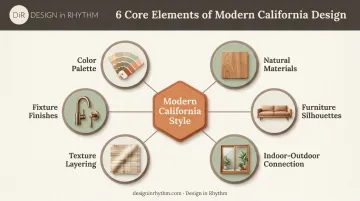
Six elements consistently show up in rooms that get this style right. Skip one, and the room starts to feel like a different style entirely.
- Color palette: Sandy whites, greige, and warm taupe as the base, with one or two muted accents like sage green or terracotta. Avoid cool gray undertones — that reads as modern farmhouse, not California
- Natural materials with sleek finishes: White oak, walnut, travertine, and linen paired with tailored hardware and clean cabinetry fronts, so the room feels elevated rather than rustic
- Furniture silhouettes: Low-slung, structured seating with clean lines. Mid-century influence shows up in case goods and lighting, not overstuffed sofas
- Indoor-outdoor connection: Large windows and sliding doors that treat the patio or garden as part of the room's actual composition, not just a view
- Texture layering: Bouclé, raw wood, unglazed ceramic, and woven rattan, kept within a tight tonal range so the room stays calm without going flat
- Fixture finishes: Aged brass or warm bronze hardware adds warmth without breaking the neutral, sun-warmed mood of the room
The through-line is restraint. Every element works with the others in tone and finish, never chosen in isolation.
How to Bring the Look Into Every Room
Living Room
Anchor the room around one low, structured sofa in linen or a performance fabric, then add a single statement natural-material piece: a travertine coffee table or a white oak media console does the job.
Keep decorative accents curated: a few ceramics, one plant, one woven throw. In the evening, swap bright overhead light for warm, low lamplight that mimics a California sunset rather than an office.
Kitchen
Pair warm wood cabinetry with a marble or quartz countertop, then finish with mixed-metal hardware. That contrast between raw material and sleek surface is the signature move of this style.
Where it's feasible, swap a small window for a larger opening or sliding door. The kitchen's connection to the outdoors matters as much as the living room's.
Bedroom & Bathroom
In the bedroom, undyed linen bedding, a wood or rattan headboard, and a neutral wool or jute rug keep the space calm and sun-washed rather than staged.
Bathrooms benefit from natural stone (travertine or marble) paired with a large mirror and one greenery accent. Skip the seashells and rope mirrors; one plant does more for the "bring the outdoors in" effect than any coastal prop.
Neutrals dominate current bathroom design, according to NKBA's 2026 Bath Trends Report, with 96% of industry professionals identifying neutrals as a leading trend. Lower-sheen matte and brushed faucet finishes are also outpacing polished chrome — a detail that pairs naturally with the aged-brass, warm-bronze direction this style favors.
Common Mistakes to Avoid When Creating This Look
The gap between a good mood board and a good room usually comes down to three recurring errors.
- Confusing it with generic coastal decor. Nautical stripes, anchors, and seashells read as theme-park, not California modern. If it looks like it belongs on a cruise ship, it doesn't belong in this style.
- Buying "on-trend" pieces individually. A travertine table here, a boucle chair there: each one looks great alone, but they rarely cohere once they're in the same room. Plan the palette and material story before you purchase anything.
- Ordering from online photos alone. Fabric color, wood tone, and scale frequently look different in person than they do in a listing photo. This is consistently one of the costliest mistakes homeowners make.
This last point is exactly why Design in Rhythm sources every product before building a single rendering. Sofia Marquez and the design team confirm materials and finishes first, so the photorealistic visuals a client approves show the actual sourced pieces, not stand-ins.
"Having a rendering of the finished space before ordering anything was a huge relief for someone who considers herself picky about details." — a Design in Rhythm client
What Does It Cost to Achieve This Look in California?
Interior designer fees vary widely depending on the model used, and there isn't a single official California rate; most published benchmarks are national. According to Angi's 2026 cost data, hourly rates typically run $100 to $500, while flat-fee projects tend to land between $2,000 and $12,000 depending on scope.
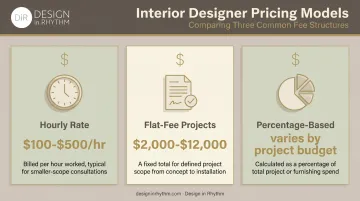
Some designers instead charge a percentage of the total project budget, and rates vary just as widely there.
Given these fee ranges, DIY sourcing can look like the cheaper route on paper. In practice, it often costs more once you factor in returns, mismatched pieces, and delivery delays. These are the exact problems a sourcing-first approach is built to avoid.
There's also a cost lever most homeowners don't have access to on their own:
- Trade-only vendor relationships built over years can unlock materials unavailable at retail
- Custom furniture makers and artisans in a firm's network often price competitively against retail markups
- Procurement handled by a dedicated logistics manager (David Chen's role at Design in Rhythm) reduces the risk of costly reordering
The upfront design fee pays for access and accuracy, not just aesthetics.
Frequently Asked Questions
What is California style interior design?
It's a blend of coastal, mid-century, and bohemian influences built around natural light, warm neutrals, and a strong connection between indoor and outdoor living spaces.
What is the 70/30 rule in interior design?
It refers to allocating roughly 70% of a room to a dominant style or color scheme and 30% to a contrasting accent. In Modern California rooms, that usually means 70% warm neutrals and 30% a muted accent like sage or terracotta.
How much does an interior designer cost in California?
Rates typically range from $100 to $500 per hour, or $2,000 to $12,000 for flat-fee projects, depending on location and scope. Full-service firms handling procurement, custom fabrication, and installation usually land toward the higher end.
What's the difference between California modern and California casual style?
Modern California is polished, geometric, and tailored. California Casual leans relaxed and rustic, with oversized, slouchy furniture and a more informal beach-house feel.
Can the Modern California look work outside of California or in a small apartment?
Yes. The palette and material choices create the look, not geography. Light walls, low furniture, and a handful of well-chosen natural-material pieces work just as well in a small space.
How long does a full room or home makeover in this style typically take?
Timelines vary by project, but early phases like space planning and mood-board development typically run 1-2 weeks each, with sourcing and installation scheduled around confirmed product lead times.