
Introduction
Home renovation project management is the process of planning, coordinating, and overseeing every phase of a remodel: budget, design, permits, procurement, and construction. The goal is a finished space that matches your original vision, on time and on budget. Sounds simple. It rarely is.
This guide is built for homeowners planning a full home remodel, a multi-room renovation, or any project pulling in several trades at once. Get the coordination wrong, and you'll feel it in your wallet and your calendar.
That's because most people talk about "staying organized" during a renovation like it's a personality trait. It's actually a discipline, with defined phases and clear responsibilities you can plan for.
Here's what we'll cover:
- What renovation project management actually means and why it matters
- How the process unfolds, step by step
- The factors that determine whether a renovation succeeds or stalls
- When to manage the project yourself versus when to bring in a professional
Key Takeaways
- Project management ties budget, design, permits, procurement, and scheduling into one process
- 31% of homeowners who renovated in 2019 finished over budget, per Houzz research
- Five phases drive the process: planning, design/permitting, procurement/scheduling, construction, and closeout
- Success depends on contingency reserves, accurate lead times, and correct trade sequencing
- Larger or design-driven renovations benefit most from a project manager or design-build team
What Is Home Renovation Project Management?
Home renovation project management is the coordinated oversight of every task, vendor, and decision involved in turning a renovation vision into a finished space. It starts with the initial budget and ends at the final walkthrough.
The goal is straightforward: a completed project that matches your budget, timeline, and original design intent, with minimal rework and even less miscommunication. No hidden complexity, just a lot of moving parts that need to move in the right order.
Keeping those parts moving in order starts with one key distinction: this is different from general contracting.
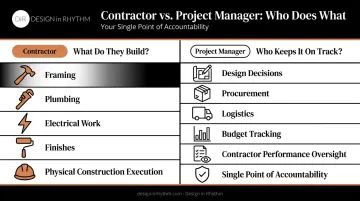
- Contractor: Executes the physical build, from framing and plumbing to electrical and finishes.
- Project manager: Oversees the ecosystem around that build, including design decisions, procurement, logistics, budget tracking, and contractor performance, all funneled through one point of accountability.
Your contractor answers "is the wall built correctly?" Your project manager answers "did the tile arrive before the plumber needed it, and are we still within budget?" Both questions matter. Only one of them tends to get asked consistently on projects without dedicated oversight.
Why Project Management Is Critical for a Successful Renovation
A renovation is really dozens of interdependent tasks stacked on top of each other: demolition, rough electrical, plumbing rough-in, inspections, drywall, finishes. Get the order wrong, and everything downstream shifts.
31% of homeowners who renovated their primary residence in 2019 finished over budget, per Houzz's 2020 Home Study of more than 87,000 respondents. Another 29% never set an initial budget at all.
Without structured oversight, a few things go wrong on repeat:
- Task order gets scrambled: flooring goes in before painting, for example, undoing finished work and forcing drop cloths and touch-ups
- Permit windows get missed: work stalls while an inspector's schedule finally opens up
- Trade schedules overlap: the electrician and the drywaller both show up expecting clear access
- Material orders arrive mismatched: wrong tile finish, wrong cabinet hardware, discovered mid-install
None of this is a legal requirement. No inspector checks whether you have a project manager on staff. It's become standard practice anyway, especially for full-home or multi-room work involving several trades, because the alternative is homeowners personally chasing five different people for updates.
Project management protects the two things homeowners care about most: budget and timeline. It creates one point of coordination instead of scattering that responsibility across you, your contractor, your tile supplier, and your cabinet maker. That's the difference between a renovation that hits its dates and one that slips a month at a time.
For design-driven or higher-end renovations, this is where integrated firms earn their keep. Design in Rhythm's single point of contact model folds coordination, logistics, construction support, and installation into one continuous operation, so clients aren't the ones tracking down a delayed vanity or mediating between trades pointing fingers at each other.
How Home Renovation Project Management Works (Step-by-Step)
Renovation PM functions as a continuous loop: planning, execution, monitoring, repeat. Budget, design decisions, and permits go in as inputs. A completed, inspected space comes out the other end.
What goes into the process:
- Defined budget parameters and contingency reserves
- Finalized design decisions and material selections
- Contractor and subcontractor availability
- Permit requirements specific to your jurisdiction
What happens during execution: the project manager sequences trades in a logical order, procures and tracks materials against delivery windows, supervises the site day to day, and measures progress against milestones, not vibes.
How it's controlled: written schedules, budget tracking tools, quality checklists, and regular check-ins, often weekly, keep everyone accountable to the same version of the plan.
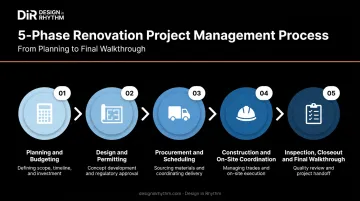
Here's how that plays out across five phases.
Step 1: Planning and Budgeting
This step defines what you're actually doing: cosmetic refresh or structural overhaul, and sets a realistic budget with room to breathe. Most guidance points to a contingency reserve of around 10% of project cost, with higher reserves recommended if you're acting as your own general contractor. Skip this step, and every surprise becomes a crisis instead of a line item.
Step 2: Design and Permitting
You finalize design decisions here: layouts, finishes, structural changes, everything that needs locking down before a permit application makes sense. Permit timelines vary enormously by jurisdiction. Aspen's building department reported ranges from roughly 1-2 weeks for simple permits up to 16-18 weeks for major residential projects in its late-2025 averages. Check your local timeline early; it affects everything downstream.
Step 3: Procurement and Scheduling
You order materials, fixtures, and long-lead items now, often before demolition even starts. Custom cabinetry, specialty tile, and designer fixtures can carry lead times of several weeks to a few months, depending on customization and manufacturer backlog.
Meanwhile, your contractor sequences subcontractor schedules to avoid downtime, so nobody's sitting idle waiting on a delivery that should've been ordered a month earlier.
Step 4: Construction and On-Site Coordination
Demolition, structural work, and trade installation happen here, and your project manager tracks progress daily against the schedule. Your team resolves issues in real time, not batching them up for a weekly call three days later.
This is also where design intent either survives contact with the build or doesn't. Someone needs to verify that the tile going in actually matches what was specified, not a close substitute a supplier swapped in.
Step 5: Inspection, Closeout, and Final Walkthrough
Inspectors check completed work against code requirements and original design specs. Your team resolves punch-list items, a scuffed baseboard, a misaligned cabinet door, before handoff. Crews clean and stage the space, then hand it back to you looking like the rendering you approved months earlier, not an approximation of it.
Key Factors That Affect Renovation Project Management
Five variables determine whether a renovation runs smoothly or turns into a slog:
- Budget accuracy and contingency reserves: Undersized contingencies are a common cause of mid-project financial strain. Pad your budget by roughly 10%, more if you're self-managing contractors.
- Material and vendor lead times: Custom cabinetry, tile, and fixtures can take weeks to months to arrive, depending on supplier backlog. Order late, and the schedule shifts with it.
- Scope complexity: Structural changes, permitting requirements, and multi-trade coordination demand far more management intensity than a cosmetic refresh.
- Team experience and vendor relationships: Established contractor and vendor networks reduce miscommunication, since expectations and quality standards are already understood on both sides. First-time pairings start from zero.
- Homeowner occupancy status: Living on-site during a renovation changes dust control, sequencing, and day-to-day coordination compared to vacating the property entirely.
Firms with a decade-plus of vendor relationships, like Design in Rhythm's network of trusted vendors, artisans, and custom furniture makers, tend to sidestep the miscommunication that comes from sourcing everything cold. Every vendor already knows the quality bar before the first order goes out.
Common Mistakes and When You Might Not Need a Full PM Team
Common Mistakes and Misconceptions
A few misconceptions come up constantly:
- "Project management is only for big remodels." Even single-room renovations need basic scheduling and budget tracking, or you'll likely repaint a wall you just tiled around.
- "My contractor already handles this." Many contractors focus on execution, not proactive scheduling or vendor coordination. Ask directly what's included before assuming.
- "On schedule" means "on budget." These are separate metrics. A project can hit every date on the calendar while unmanaged change orders drain the budget.
When a Full PM Team Isn't Necessary
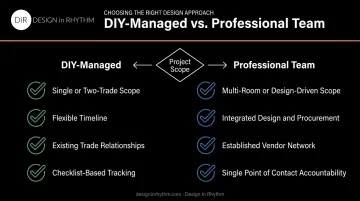
Small, single-trade projects like painting or a fixture swap rarely need formal project management. A checklist and one point of contact usually covers it.
DIY-managed renovations can work when:
- The scope is limited to one or two trades
- The timeline has flexibility built in
- You already have direct relationships with the trades involved
Complex, multi-room, or design-driven renovations are where the calculus flips. An integrated team handling design, procurement, and logistics together earns its cost here, removing the vendor-chasing and contractor-management that otherwise falls entirely on the homeowner.
Design in Rhythm applies this model across full home remodels in Los Angeles and Santa Barbara, as well as smaller-scope apartment and single-space projects. The same single point of contact holds regardless of project size.
Whether you go DIY or bring in professional help, successful renovation project management comes down to the same three things: plan ahead, sequence correctly, and keep accountability in one place throughout.
Frequently Asked Questions
How do you manage a home renovation project?
Set a clear scope and budget with contingency built in, sequence tasks in a logical order, coordinate vendors and permits ahead of time, and track progress against a written schedule.
How much remodeling can you do with $100,000?
JLC's 2025 national benchmarks put a midrange major kitchen remodel at roughly $82,793 and an upscale bath remodel at $81,612, meaning $100,000 typically covers one major room or several mid-range updates.
What's the difference between a project manager and a general contractor?
A contractor executes the physical construction, while the project manager oversees the entire process, budget, design, vendors, and schedule, as the central point of accountability.
How long does a typical home renovation take from planning to completion?
Timelines vary widely by scope. Permitting alone can take anywhere from a couple of weeks to several months, depending on jurisdiction. Full-home renovations often span multiple months once design and procurement are factored in.
What is the 30% rule in remodeling budgets?
It's a rule of thumb suggesting you shouldn't spend more than roughly 30% of your home's current value on a renovation, to avoid over-investing relative to what the market will support.
What tools or software help track a renovation project?
Cloud-based construction management platforms, shared digital documentation hubs, and budget-tracking spreadsheets or apps keep homeowners, contractors, and designers aligned on the same numbers and schedule in real time.