Introduction
Walk into a forgettable hotel lobby and nothing happens. Walk into a great one and something shifts — you feel it before you can name it.
For boutique hotels, that moment is everything. Guests form opinions fast, and a lobby that fails to communicate a clear identity makes recovery difficult. As hospitality designer Douglas Nysse put it: "If you lose them at the beginning, it is very hard to recover."
The stakes are measurable. Cornell University's analysis of 95,500 hotel reviews found that "front" and "desk" appeared almost exclusively in low-rated reviews — arrival experiences carry outsized weight on overall perception.
That same research found boutique hotels under 100 rooms averaged 0.41 points higher in guest ratings than properties with 250+ rooms. It's a size advantage that smart lobby design can amplify.
This article covers 7 genuinely unique hotel lobby design ideas — drawn from proven hospitality projects and real design principles — that boutique hotel owners and developers can use as a starting point for their own spaces.
Key Takeaways
- The lobby sets the emotional tone for an entire stay — and no other space delivers a higher return on your design investment
- Unique design is a commitment to intention and authenticity that reflects your specific property
- Seven distinct design approaches — from biophilic elements to sensory layering — each offer a proven path to a memorable lobby
- Execution matters as much as concept: sourcing, lead times, and sequencing determine whether the vision lands
- Smaller footprint is an advantage: boutique hotels can deliver intimacy and curation that large chains simply cannot replicate
Why Your Hotel Lobby Is Your Most Powerful Design Asset
For younger travelers, the hotel lobby is no longer just a passageway — it's a destination.
Gensler's Hospitality Experience Index found that Millennials are 2.9 times more likely than Boomers to use hotels to meet clients, and 42% of hotel guests use the lobby to work somewhere quiet. Add Gen Z's well-documented preference for communal spaces that feel activated — not staged — and the lobby's role as a social and professional hub is now central to how guests choose and review a property.
That behavioral shift creates a real opening for boutique properties. Large chain hotels operate under brand standards that constrain creative decisions. An independent boutique hotel can design a lobby that is entirely its own — one that no franchise guidebook will ever replicate.
The business case for lobby investment is direct:
- First impressions drive review scores — Cornell's data shows front-of-house experience has an outsized effect on overall guest ratings
- Dwell time drives ancillary revenue — guests who linger in a well-designed lobby spend more on F&B and in-house services
- Memorable spaces generate organic marketing — a lobby guests photograph and share extends your marketing reach without additional spend
7 Most Unique Hotel Lobby Design Ideas
These ideas span different design philosophies — from nature-forward to art-forward, from layered maximalism to quiet sensory immersion. "Unique" is not a single aesthetic. It is a commitment to intention.
1. Biophilic Living Lobbies
Biophilic design brings the natural world into the built environment through living walls, cascading greenery, natural light wells, and organic materials. Done well, it makes nature the architectural hero of the space — not a decorative accent.
The 1 Hotel Mayfair in London is a benchmark here. Patrick Nadeau's "Rainforest" living chandelier, made with air plants, creates an immediate sensory shift upon arrival. The reception desk is carved from a naturally fallen 200-year-old Sussex oak; a dry-stone wall was assembled by local artisans from reclaimed Yorkshire stone. Nature is not decorating the lobby — it is the lobby.
The numbers support the investment. Human Spaces' research across 100 hotels found a 36% higher dwell rate in biophilic lobbies and twice as many guest review mentions of "experience."
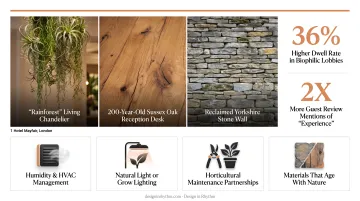
Design considerations worth planning for:
- Humidity and HVAC management for living plant installations
- Natural light sourcing or supplemental grow lighting
- Ongoing maintenance partnerships with horticultural specialists
- Material selection that ages well alongside living elements
2. Cultural Storytelling Through Local Art and Craft
A lobby that commissions locally sourced artwork, regional artisan crafts, and materials native to the area creates a sense of place that no chain hotel can replicate — because it cannot be standardized.
Two examples show how this works. At Moxy Sydney Airport, designers MAED Collective wove Art Deco references from nearby heritage storefronts into an industrial scheme, incorporating a facade mural by Elliott Routledge alongside regional artists' work. At Headlands Coastal Lodge & Spa in Oregon, the reception desk features illuminated laser-cut steel openings depicting local geese, a driftwood sculpture on top, and a Pendleton blanket hung as a tapestry behind it. Every surface tells you exactly where you are.
Guests who feel a genuine connection to a place are more likely to photograph it, share it, and return. That behavioral loop is the commercial case — and it starts with the lobby.
3. The Dramatic Statement Piece
Rather than designing the lobby as a complete environment from scratch, this approach builds the entire room around one singular, unforgettable installation. The installation carries the whole story.
The Reverie Saigon placed a five-meter Colombostile sofa — Baroque-meets-Rococo, upholstered in purple ostrich leather, edged with gilded trim, set with an amethyst — at the center of its seventh-floor lobby. Nearby throne armchairs use 22-karat gold leaf. You don't need a single word of copy to understand what kind of hotel this is.
At Faena Hotel Miami Beach, Damien Hirst's "Gone But Not Forgotten" — a woolly mammoth skeleton gilded in 24-karat gold — anchors the outdoor Mammoth Garden. Creative direction by filmmaker Baz Luhrmann and designer Catherine Martin gives the entire property a theatrical, golden-age-glamour identity.
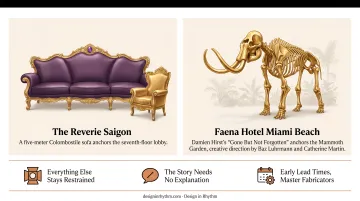
This approach requires real discipline to execute:
- The rest of the lobby must be intentionally restrained — competing installations dilute each other's impact
- The piece should communicate the hotel's brand story without explanation
- Commissioning requires early lead times and vendor relationships with fabricators who can work at this scale
4. Adaptive Multi-Zone Lobby Design
Instead of a lobby that serves only as an arrival point, adaptive zoning transforms the space into a layered environment — check-in, co-working, social dining, casual lounge, and retail coexisting without visual chaos.
This matters particularly for boutique hotels serving business travelers and digital nomads. Gensler's data shows 42% of hotel guests already use lobbies to work. Designing for that behavior — rather than fighting it — keeps guests in-house longer and increases F&B and ancillary revenue naturally.
What makes multi-zoning work:
- High-backed seating creates implied privacy without walls
- Varied lighting zones — task lighting in work areas, warm ambient light in social areas — signal which zone is which
- Acoustic materials integrated into walls, ceilings, and soft furnishings control sound bleed between zones
- Furniture groupings define territories without requiring physical barriers
A well-zoned boutique lobby can function as a hotel amenity, a neighborhood co-working spot, and a social gathering space simultaneously — three revenue and reputation streams from one room.
5. Theatrical Maximalism
Maximalism in a hotel lobby context is not clutter. It is deliberate layering — bold color, rich textures, curated objects, abundant pattern — executed with an underlying logic that makes the whole feel intentional rather than accumulated.
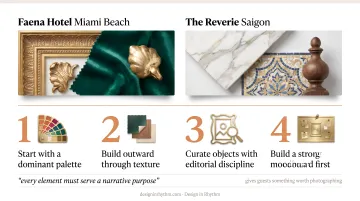
Faena Hotel Miami Beach and The Reverie Saigon are the standard-bearers. Faena's interiors combine gilded elements, vibrant murals, and jewel-toned furnishings under a clear golden-age-glamour narrative. The Reverie layers Italian palazzo inspiration — marble, gold, mosaic, carved wood — into a cohesive visual language that feels specific rather than excessive.
The fine line between maximalism and chaos: every element must serve a narrative purpose, and the palette must share an underlying logic. In practice, this means:
- Start with a dominant palette — one or two anchoring colors that everything responds to
- Build outward through texture — introduce pattern and material contrast gradually
- Curate objects with editorial discipline — ask whether each addition advances the story or just adds noise
- Build a strong mood board first — get alignment on the feeling before selecting individual pieces
For boutique hotels in competitive markets, a maximalist lobby gives guests something worth photographing — and that organic reach compounds in ways a paid campaign can't replicate.
6. Heritage Reuse with Contemporary Contrast
When a hotel occupies a historic building — a former bank, church, telephone exchange, or industrial warehouse — the architecture itself is the hero. The designer's job is to celebrate what's there, not cover it.
The Ned London opened in 2017 in the former Midland Bank headquarters designed by Sir Edwin Lutyens in 1924 — a Grade I listed building. The banking hall's original columns, carved stone, and ironwork balustrades are preserved and contrasted with contemporary furnishings and modern lighting. The result is a lobby with a grandeur no new-build can manufacture.
Ace Hotel Kyoto took a similar approach in the former Kyoto Central Telephone Company building from the 1920s, combining Kengo Kuma's new structure with renovated historic interiors that mix Japanese craft with contemporary references.
Contrast is what makes heritage reuse feel alive. New against old creates visual tension — and that tension gives a hotel genuine character that no new-build can manufacture from scratch.
A practical note for boutique hoteliers: before demolishing anything in an older building, audit existing architectural features with a preservation lens. Original ironwork, carved plasterwork, or exposed industrial structure may be the most commercially valuable design asset in the space — and once it's gone, it cannot be recovered.
7. Sensory-First Lobby Design
Most lobby design briefs address the visual. The best ones treat scent, sound, acoustic texture, and lighting temperature as primary design tools alongside furniture and finishes.
A Journal of Marketing meta-analysis of 64 studies — covering 15,447 respondents including hotel settings — found that pleasant ambient scent was associated on average with 11.3% greater brand recall, 5.0% more lingering, and 6.7% higher purchase intentions. A 2024 research chapter specifically on hotel lobby music found positive effects on customer satisfaction and willingness to spend time in the space.
The sensory touchpoints a boutique hotel lobby brief should specify:
| Sensory Element | Design Specification |
|---|---|
| Scent | Signature diffusion system; scent tied to brand identity |
| Sound | Curated music strategy aligned with hotel character; water features as ambient sound sources |
| Acoustics | Acoustic panels in walls or ceilings; soft furnishings as sound management tools |
| Lighting | 2700–3000K warm ambient base; layered accent highlights; CRI 80+ |
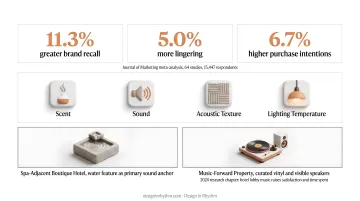
A spa-adjacent boutique hotel might use a water feature as its primary sound anchor. A music-forward property might feature curated vinyl and visible speakers as a deliberate design element. The specific tools matter less than the intentionality behind them — a lobby should have a sensory signature as distinct as its visual identity.
What to Consider Before Choosing Your Hotel Lobby Design Direction
The most unique hotel lobbies are not defined by trend — they are defined by fit. The design direction should emerge from the hotel's brand story, target guest profile, and physical architecture.
A biophilic concept belongs in a wellness-forward property with natural light to support it. Theatrical maximalism suits a high-energy urban boutique fighting for attention in a crowded market. Heritage reuse only works if the building has genuine history worth preserving — otherwise it reads as decoration. Fitting the aesthetic to the property is not a creative constraint; it's the work itself.
Start here before selecting a direction:
- What story does this hotel tell, and who is it telling it to?
- What does the physical architecture already offer — and what does it demand?
- What behaviors do guests engage in when they arrive and linger?
- What is the one thing you want a guest to photograph and remember?
The second gap that derails most hotel lobby projects is execution. A strong visual concept means nothing if procurement and logistics aren't managed with the same rigor. Bespoke furniture, commissioned artworks, and custom installations all require lead times, vendor relationships, and installation sequencing planned from day one.
This is where an integrated firm makes the difference. Design in Rhythm, for example, sources every product before generating renderings — so what clients approve is exactly what arrives on-site, with no late substitutions.
For boutique hotels under 100 rooms: resist the impulse to over-program a small footprint. A smaller lobby, designed with precision and a single clear direction, creates the kind of intimacy and atmosphere that larger hotels actively spend money trying to recreate.
Conclusion
Biophilic living lobbies, cultural storytelling, the dramatic statement piece, adaptive multi-zone design, theatrical maximalism, heritage reuse, sensory-first design — seven very different aesthetics, one shared requirement: a lobby that knows precisely what it is and who it's for.
Travelers choosing boutique hotels are choosing them for the depth of experience they offer. The lobby is where that promise either lands or falls apart, before a single room key changes hands.
If you're a boutique hotel owner or developer ready to build a lobby that guests remember, Design in Rhythm handles the full process — discovery, design, procurement, and installation — so nothing gets lost between concept and opening day. Reach out to start the conversation.
Frequently Asked Questions
What makes a hotel lobby design truly unique?
A truly unique hotel lobby reflects the specific identity, story, and guest profile of the property through intentional choices in materials, art, layout, lighting, and sensory experience. The test is simple: could this lobby belong to any other hotel, or only this one?
What are the most important design elements in a hotel lobby?
The essentials are lighting temperature and layering, zoning for multiple guest behaviors, furniture aligned with brand style, sensory elements like scent and sound, and at least one focal design feature that anchors the space. A lobby without that focal point tends to feel unresolved, regardless of budget.
How do I make a small boutique hotel lobby feel impressive?
Intention makes a lobby impressive, not scale. A small lobby with a strong statement piece, curated materials, warm layered lighting, and a clear design narrative can feel more impactful than a large generic space. For boutique hotels, intimate scale is an advantage, not a constraint.
What is biophilic design and why is it popular in hotel lobbies?
Biophilic design integrates natural elements such as living plants, water features, natural light, and organic materials into built environments. Its popularity in hotels comes from a documented link to reduced stress and improved wellbeing — guests feel it the moment they walk in.
What are the current trends in hotel lobby design?
Leading directions include biophilic and sustainability-forward design, flexible multi-use lobbies that blend social and working spaces, locally rooted cultural storytelling, sensory branding, and the shift away from formal front desks toward more relaxed, human-centered arrival experiences.
How long does it typically take to design and execute a hotel lobby renovation?
A boutique hotel lobby renovation from initial concept to final installation typically spans several months to over a year, depending on scope. Working with a firm that manages procurement and logistics in-house rather than coordinating separate vendors can reduce that timeline considerably.