This article breaks down what each discipline actually covers, where they overlap, and how to figure out which one your project calls for.
Key Takeaways
- Interior architecture addresses structural and spatial decisions — walls, systems, layouts, and code compliance
- Interior design focuses on the experiential layer: how a finished space looks, feels, and functions for the people inside it
- Both disciplines share territory in space planning, material specification, and lighting design
- Structural changes require interior architecture expertise; transforming a finished space calls for interior design
- Most hospitality and full-home remodel projects benefit from both — interior architecture first to reshape the space, interior design to bring it to life
Interior Architecture vs. Interior Design: A Quick Comparison
Here's how the two disciplines compare across the factors that shape real project decisions:
| Dimension | Interior Architecture | Interior Design |
|---|---|---|
| Primary focus | Structural and spatial organization | Aesthetic and experiential quality |
| Core scope | Layouts, building systems, structural modifications | Furniture, finishes, lighting, materials, decor |
| Licensing | Governed by state architecture boards (NCARB covers 55 jurisdictions) | 31 states + DC and Puerto Rico have some form of legal recognition |
| Typical entry point | New builds, conversions, gut renovations | Finished or near-finished spaces |
| Key collaborators | Engineers, contractors, building officials | Clients, vendors, artisans, craftspeople |
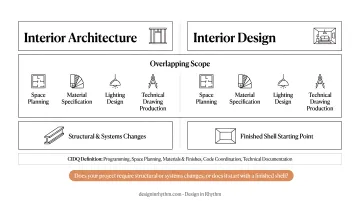
The overlap between these professions is wider than most clients expect. Space planning, interior material specification, lighting design, and technical drawing production all appear in both scopes. CIDQ's formal definition of interior design explicitly includes programming, space planning, materials and finishes, code coordination, and technical documentation — work that many assume belongs exclusively to architecture.
Knowing which professional you actually need comes down to one question: does your project require structural or systems changes, or does it start with a finished shell? That answer determines where to begin.
What Is Interior Architecture?
Interior architecture is concerned with how a building's interior spaces are structured, organized, and built. It starts with the bones: the structural layout, load paths, and building systems — before any furniture or finishes enter the conversation.
Core Scope of Work
An interior architect's responsibilities typically include:
- Space planning to maximize flow, function, and structural logic
- Modifying structural elements — walls, ceilings, floors, and openings
- Integrating building systems — HVAC, plumbing, electrical, and fire safety
- Specifying surfaces and finishes that meet structural and code requirements
- Ensuring code compliance and coordinating with building officials throughout
Adaptive Reuse: A Defining Concern
Adaptive reuse is where interior architecture's structural demands become most visible. It means taking an existing building and reimagining it for an entirely different purpose — and the constraints that come with that are architectural, not decorative.
The NoMad Los Angeles hotel is a clear example: a 1920s Bank of Italy building in downtown LA was transformed into a boutique hotel, as documented by Metropolis. The vault spaces, ceiling heights, and load-bearing walls all had to be reinterpreted for a hospitality program. That kind of transformation requires deep architectural thinking before any aesthetic decisions are made.
According to AIA's 2024 Firm Survey, 45% of U.S. architecture-firm gross billings in 2023 came from renovations — a figure that reflects just how much of the profession's work involves transforming existing structures.
Licensing
In the U.S., using the title "architect" is governed by individual state boards. NCARB covers requirements across all 55 jurisdictions and maintains a licensing requirements tool where you can verify what's required in your state. There is no separate nationwide "interior architect" license. Practitioners hold a standard architecture license — NCARB's tool lets you confirm requirements for your specific state.
What Is Interior Design?
Interior design creates environments that are beautiful, functional, and aligned with how the people inside them actually live or work. It operates within a structurally complete — or nearly complete — space and focuses on what fills it and how that makes people feel.
Core Scope of Work
- Developing color palettes and material schemes
- Selecting furniture, custom pieces, and built-ins
- Sourcing textiles, lighting fixtures, window treatments, and accessories
- Specifying finishes that tell a cohesive visual story
- Space planning for flow, function, and furniture placement
- Producing technical drawings, floor plans, and specifications
A Client-Centered Process
The best interior design work starts with listening, not presenting. Design in Rhythm's process illustrates this well: before any design work begins, the team conducts in-depth discovery conversations — walking the space with clients, asking how it gets used day-to-day, and documenting lifestyle habits that most designers never think to ask about. That discovery shapes everything that follows.
What sets their approach apart is the sequencing: every product is sourced before photorealistic 3D renderings are produced. Clients see their actual furniture, finishes, and fixtures — not approximations — before a single item is ordered.
As one client noted: "I had a rendering of my would-be apartment before getting started, so being very picky, it was a huge relief to have that."
Specializations Within Interior Design
That client-centered foundation shapes every category of interior design — and each specialization demands a different understanding of how people inhabit a space:
- Residential — homes, apartments, full remodels; deeply personal, centered on how a household actually functions
- Hospitality — hotels, restaurants, bars; design directly shapes guest perception and drives revenue
- Commercial — offices, co-working spaces, retail; balances brand identity with operational efficiency
Licensing and Credentials
Interior designers in the U.S. do not universally require a license, though NCIDQ certification exists as a competency credential. Currently, 31 states plus Washington, DC, and Puerto Rico have some form of legal recognition for interior design — ranging from practice acts to title protections. When vetting a designer, portfolio, process, and client references tell you more than credentials alone.
Which Do You Actually Need?
Choose Interior Architecture When:
- Walls are moving or being removed
- The building is changing from one use to another (office to hotel, bank to restaurant)
- Plumbing or HVAC systems are being relocated or redesigned
- The project requires permits tied to structural work
- You're gut-renovating or dealing with code compliance issues
In each of these situations, the architect resolves structure and systems before design work can begin.
Choose Interior Design When:
- The structure is sound and you're transforming how the space looks, feels, and functions
- You want furniture, finishes, materials, and lighting to create a specific experience
- The goal is a space that reflects your identity, brand, or lifestyle
- You need someone who will manage sourcing, procurement, and installation — not just hand you a mood board
When You Need Both
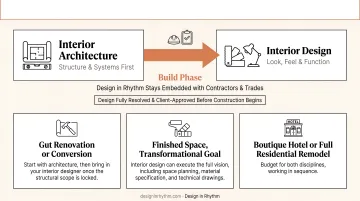
Full home remodels, hospitality builds, and commercial fit-outs often require both disciplines. The typical sequence: interior architecture handles structure and systems first; interior design then shapes how the finished space looks, feels, and functions.
Design in Rhythm works within this sequence. For projects involving structural changes, the firm coordinates directly with contractors and trades during the Build Phase — staying embedded throughout to ensure design intent carries through to the built environment.
The design is fully resolved and client-approved before construction execution begins, which means contractors work from a locked brief rather than an evolving one.
A practical guide:
- Gut renovation or conversion? Start with architecture, then bring in your interior designer once the structural scope is locked.
- Finished space, transformational goal? Interior design can execute the full vision — space planning, material specification, and technical drawings included.
- Boutique hotel or full residential remodel? Budget for both disciplines, working in sequence.
Conclusion
Interior architecture defines the structural and spatial framework. Interior design gives that framework a voice — one that reflects who you are or what your brand stands for. Both matter, but they answer different questions at different stages of a project.
If walls are moving or systems are changing, start with architecture. If the structure is set and the goal is a space that genuinely connects with people — guests, clients, or the people who live there — bring in an interior design team with the process, trade access, and creative range to make that happen.
Design in Rhythm offers a free consultation to walk through what that engagement looks like for your specific project.
Frequently Asked Questions
What is interior design architecture?
"Interior design architecture" isn't a formal industry term. It's used loosely to describe the intersection of the two disciplines — the planning and design of interior spaces that considers both structural spatial logic and aesthetic experience. Work described this way typically lives in the overlap between the two professions.
What are the 7 layers of interior design?
The seven layers come from Christopher Lowell's consumer decorating framework, not a professional industry standard. His sequence covers paint and architectural embellishments, installed flooring, high-ticket upholstery, accent fabrics, non-upholstered furniture, accessories, and plants and lighting. Useful as a room-building guide for consumers, but not a formal professional methodology.
Can you do both architecture and interior design?
Yes. Some professionals hold credentials in both disciplines, and many firms staff both roles on the same team — especially in hospitality and complex residential remodels where structural and aesthetic decisions need to stay tightly coordinated.
Do I need an interior architect or an interior designer for my renovation?
If the renovation involves moving walls, modifying building systems, or changing the building's use, an interior architect is likely needed — often before a designer is engaged. If the structure stays intact and the goal is transforming how the space looks and feels, an interior designer is typically the right professional.
Is interior architecture more expensive than interior design?
Projects involving structural complexity, engineering coordination, permits, and licensed professionals tend to carry higher overall costs. But fees vary significantly based on project scope, market, and firm — ASID notes there's no universal "typical" fee structure. Request project-specific quotes from both types of professionals before budgeting.
What does an interior designer do that an architect doesn't?
An interior designer focuses on the experiential layer — furniture, finishes, color, and the direct client relationship — to ensure the space reflects a lifestyle or brand. That sensory, client-centered focus is distinct from an architect's structural and technical scope, even when both professionals are on the same project.