Introduction
The lobby of a boutique hotel has about 30 seconds to earn a guest's trust. A restaurant's interior shapes whether diners return before the food even arrives. These aren't aesthetic niceties — they're business outcomes tied directly to first impressions.
Poor design execution compounds the problem. Procurement delays push back opening dates. Mismatched deliveries mean the space you approved looks nothing like the space you received. For hospitality operators especially, every week a property sits unfinished is revenue that won't come back.
The right firm owns the entire process — from the first discovery conversation through final installation, so you never have to act as your own project manager.
This article covers a curated selection of full-service interior design agencies worth knowing, what distinguishes each one, and how to evaluate which type of firm fits your project.
Key Takeaways
- Full-service agencies manage discovery, design, procurement, logistics, and installation as one integrated process.
- Pre-rendering sourcing eliminates the gap between what clients approve and what actually gets installed.
- Sector specialization matters — hospitality-focused firms bring vendor depth and timeline discipline that generalist studios often lack.
- Evaluate firms on execution capability, not just portfolio aesthetics.
- Partner fit depends on project scale, sector, and how much hands-on involvement you want.
What Is a Full-Service Interior Design Agency?
"Full-service" is one of those phrases that gets stretched to cover a lot of ground. In interior design, it should mean one specific thing: the firm handles every phase of the project, not just the creative portion.
According to ASID guidance on interior design services, a comprehensive engagement covers concept development, specifications, purchasing services, project administration, contractor supervision, and final installation. The key phrase is project administration — that's the work most clients don't see but feel acutely when it's missing.
What Full-Service Actually Covers
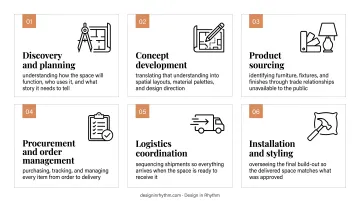
A true full-service agency manages:
- Discovery and planning — understanding how the space will function, who uses it, and what story it needs to tell
- Concept development — translating that understanding into spatial layouts, material palettes, and design direction
- Product sourcing — identifying furniture, fixtures, and finishes through trade relationships unavailable to the public
- Procurement and order management — purchasing, tracking, and managing every item from order to delivery
- Logistics coordination — sequencing shipments so everything arrives when the space is ready to receive it
- Installation and styling — overseeing the final build-out so the delivered space matches what was approved
Why This Matters for Hospitality Clients
Procurement lead times are a real variable. CoStar reported that hotel case goods moved from 18–22 weeks to 32–36 weeks during supply-chain disruptions, with custom drapery requiring 18–24 weeks from measurement through installation. A firm managing those timelines proactively is operating very differently from one that hands off a specification document and steps away.
The same coordination burden applies to residential projects. Without a full-service partner managing vendors, tracking shipments, and sequencing installation, clients absorb weeks of administrative work that has nothing to do with the end result they hired a designer to create.
Top Full-Service Interior Design Agencies You Should Know
These firms were selected based on end-to-end service capability, portfolio quality, sector specialization, and the depth of their vendor and trade networks.
Design in Rhythm
Founded by Jon Wheat — a musician-turned-designer with over a decade of industry experience — Design in Rhythm is a full-service interior design firm serving boutique hospitality and luxury residential clients across Los Angeles, Santa Barbara, Las Vegas, and New Jersey. The integrated team handles design, procurement, logistics, construction support, and final installation under one roof.
What separates Design in Rhythm from most firms is its pre-rendering sourcing process: every product is sourced from the firm's exclusive trade network before a single rendering is created. When clients review photorealistic 3D presentations, they're looking at the exact materials, furniture, and finishes that will physically arrive on-site — not concept placeholders or aspirational imagery.
This approach eliminates the common gap between what clients approve and what gets delivered. As the firm puts it: "Design without visualization is a leap of faith." By sourcing first, that leap disappears.
The firm's decade-long trade relationships provide access to exclusive vendors, artisans, and custom furniture makers — the same network relied upon by the world's top design firms — unavailable through mainstream retail channels.
| Aspect | Details |
|---|---|
| Specialty | Boutique hotels (under 100 rooms), restaurants, bars, luxury full-home remodels, commercial spaces |
| Notable Clients | Wood Partners, Gensler, Mack Real Estate Group, Patagonia, Sonos |
| Key Differentiator | Products sourced before renderings are created; single point of contact from kickoff to final installation; exclusive trade vendor network built over 10+ years |
Gensler
Gensler is one of the world's largest architecture and integrated design firms, operating approximately 57–58 offices globally with more than 6,000 professionals. Their interior design practice spans hospitality, commercial, workplace, residential, and mixed-use sectors at a scale few firms can match.
What sets Gensler apart is proprietary research. The Gensler Experience Index — built from surveys of 4,000+ U.S. respondents and 60+ hours of ethnographic interviews — measures how design affects behavior across five modes: Task, Social, Discovery, Entertainment, and Aspiration. Completed projects include the Hyatt Regency Irvine (redesigned public spaces, dining, meeting areas, and 500+ rooms) and the Wenzhou Marriott Hotel (314 rooms with locally informed interiors).
| Aspect | Details |
|---|---|
| Specialty | Commercial, hospitality, mixed-use, residential, and workplace interiors |
| Notable Projects | Hyatt Regency Irvine; Wenzhou Marriott Hotel |
| Key Differentiator | Proprietary Experience Index research framework; multidisciplinary architecture and interiors under one team |
HBA (Hirsch Bedner Associates)
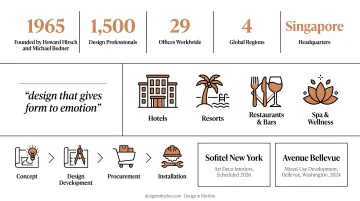
Founded in 1965 by Howard Hirsch and Michael Bedner, HBA has grown to 1,500 professionals across 29 offices in four regions, with its headquarters in Singapore. Their approach — described as "design that gives form to emotion" — spans hotels, resorts, restaurants and bars, and spa and wellness environments, with documented capabilities from concept through procurement and installation.
Few firms match HBA's depth within hospitality. Every project category they pursue — hotels, resorts, restaurants, spas — is an environment where design execution has direct business consequences. Recent work includes Art Deco interiors for the Sofitel New York (scheduled 2026) and the mixed-use Avenue Bellevue development in Bellevue, Washington (2024).
| Aspect | Details |
|---|---|
| Specialty | Hotel, resort, restaurant and bar, spa and wellness interior design |
| Notable Projects | Sofitel New York redesign (arrival, reception, ballroom, suites); Avenue Bellevue hotel and luxury residential |
| Key Differentiator | Concept-to-completion delivery with procurement capability; 29 global studios; deep hospitality specialization across all property formats |
Rockwell Group
Founded in 1984, Rockwell Group operates from New York, Los Angeles, and Madrid. The interdisciplinary studio covers architecture and interiors across hotels, restaurants, entertainment venues, cultural institutions, and residential projects — with an additional practice dedicated to theater and experiential design.
Rockwell Group designs spaces as performances. Every circulation path, lighting choice, and material selection contributes to a story the guest or diner experiences — a philosophy that makes even a restaurant feel like a stage.
That approach shows up in recent work: the 2024 Coqodaq restaurant in New York — a 4,300-sq.-ft. space using arches, theater lights, and a catwalk to create a "cathedral-like" dining environment — earned a Best of Year recognition from Interior Design. The View at the New York Marriott Marquis (reopened 2025) reimagined the rotating dining room with blue velvet curtain references and choreographed skyline views.
| Aspect | Details |
|---|---|
| Specialty | Restaurants, hotels, entertainment venues, cultural and performance spaces |
| Notable Projects | Coqodaq, New York (2024); The View at New York Marriott Marquis (2025) |
| Key Differentiator | Theatrical, narrative-led design philosophy; cross-disciplinary architecture, interiors, and experiential capability |
Meyer Davis
Founded in 1999 by Will Meyer and Gray Davis, Meyer Davis is a New York City-based architecture and design studio working across hospitality, residential, retail, and workplace environments. Their philosophy centers on proportion, materiality, and light — where restraint itself becomes the defining design move.
Their portfolio demonstrates range: the W Rome (a 162-room, 13-suite hotel created from two 19th-century buildings, featuring 200+ custom furniture pieces, recognized with a Best of Year award in 2022) and the Four Seasons Cabo del Sol in Baja (96 rooms and suites, 61 residences, eight restaurants and bars, and a spa, covered by Elle Decor in 2024). Meyer Davis's public-facing site documents architecture and design scope clearly, though procurement and logistics delivery are not detailed to the same degree as some other firms on this list.
| Aspect | Details |
|---|---|
| Specialty | Luxury boutique hospitality, high-end residential, and retail interior design |
| Notable Projects | W Rome (2022 Best of Year); Four Seasons Cabo del Sol (2024) |
| Key Differentiator | Materiality, architectural restraint, and editorial precision across intimate and large-scale environments |
How We Chose These Agencies
The Evaluation Framework
These agencies were assessed across four dimensions:
- Whether the firm manages procurement, logistics, and installation — not just creative output
- Demonstrated specialization in the project types they claim to serve
- Access to exclusive makers, artisans, and fabricators unavailable through retail
- Consistency across the full portfolio, not just the highlight reel
These criteria matter more than most clients realize. The most common mistake: choosing a firm based entirely on visual portfolio without evaluating execution capability. A concept that arrives late, over budget, or mismatched to the rendering creates real consequences — particularly in hospitality, where opening timelines are tied directly to revenue.
Matching Firm Scale to Project Needs
The right agency depends on what you're building and how you want to work:
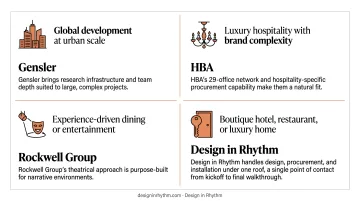
- Global development at urban scale: Gensler brings research infrastructure and team depth suited to large, complex projects
- Luxury hospitality with brand complexity: HBA's 29-office network and hospitality-specific procurement capability make them a natural fit
- Experience-driven dining or entertainment: Rockwell Group's theatrical approach is purpose-built for narrative environments
- Boutique hotel, restaurant, or luxury home: Design in Rhythm handles design, procurement, and installation under one roof — a single point of contact from kickoff to final walkthrough
Conclusion
The right full-service interior design agency does more than produce beautiful renderings — it protects your timeline, manages your vendors, and delivers exactly what was promised from the first concept to the final installation.
When evaluating firms, look beyond the portfolio. Ask about their procurement process. Find out who your point of contact will be six months in, and whether the design they show you is built on sourced products or conceptual placeholders.
If you're planning a boutique hotel, restaurant, bar, or luxury residential project and want a team that handles design, procurement, and installation under one roof — Design in Rhythm delivers exactly that: one integrated team managing every phase, with products sourced before your renderings are even finalized. Start with a free discovery conversation to discuss your project.
Frequently Asked Questions
What is a full-service design agency?
A full-service interior design agency manages the entire project lifecycle — from discovery and concept development through sourcing, procurement, logistics, and installation. Unlike partial-service designers, they own execution all the way through to the finished space, not just the design deliverable.
How much does a full-service design agency cost?
Costs vary based on project scope, square footage, customization level, and the firm's positioning. ASID notes there is no single "typical" fee — structures include flat fees, hourly rates, cost-plus purchasing, and percentages of construction or merchandise cost. A direct consultation is the most reliable way to get an accurate range.
What services does a full-service interior design agency typically offer?
Core services typically cover: space planning, concept development, photorealistic renderings, furniture and material selection, trade procurement, vendor coordination, logistics management, and installation oversight. Some firms extend this to include construction support and custom furniture fabrication.
How do I choose the right full-service interior design agency for my project?
Evaluate sector specialization (hospitality vs. residential), portfolio consistency across projects, vendor network depth, and project management approach. Also confirm whether the agency offers a single dedicated point of contact from start to finish — that structure has a direct impact on how smoothly the project runs.
What is the difference between a full-service and a partial-service interior design agency?
Partial-service designers deliver a concept, mood board, or specification document and leave procurement and installation to the client. Full-service agencies own the entire execution lifecycle, handling sourcing, vendor management, logistics, and installation so the client doesn't have to.
Do full-service interior design agencies work on both residential and commercial projects?
Many do, though some firms specialize exclusively in one sector. Firms with strong hospitality portfolios often serve high-net-worth residential clients as well, given the overlap in material quality standards, custom fabrication requirements, and the level of coordination those projects demand.